
What Is SBIR? The Hidden Reason Your Speakers May Sound Disappointing

You've Bought Great Speakers. So Why Doesn't Your System Sound Great?
You've upgraded the speakers.
You've upgraded the amplifier.
You've experimented with cables, streamers, DACs, and perhaps even room correction.
Yet something still feels off.
The bass lacks impact.
Vocals don't quite lock into place.
The soundstage feels shallow.
The system sounds good, but not extraordinary.
This experience is incredibly common in both hi-fi and home theater systems.
Many enthusiasts assume the equipment is the problem. They begin another upgrade cycle, hoping the next purchase will finally unlock the performance they are chasing.
Often, the problem isn't the equipment at all.
It's SBIR.
Speaker Boundary Interference Response, commonly known as SBIR, is one of the most common and least understood acoustic problems in domestic listening rooms.
It affects modest systems.
It affects flagship systems.
And it can dramatically reduce the performance of even world-class loudspeakers.
The good news is that SBIR can usually be identified, measured, and improved.
Understanding it is often one of the biggest steps toward achieving better sound.
What Is SBIR?
SBIR stands for Speaker Boundary Interference Response.
The concept is simple.
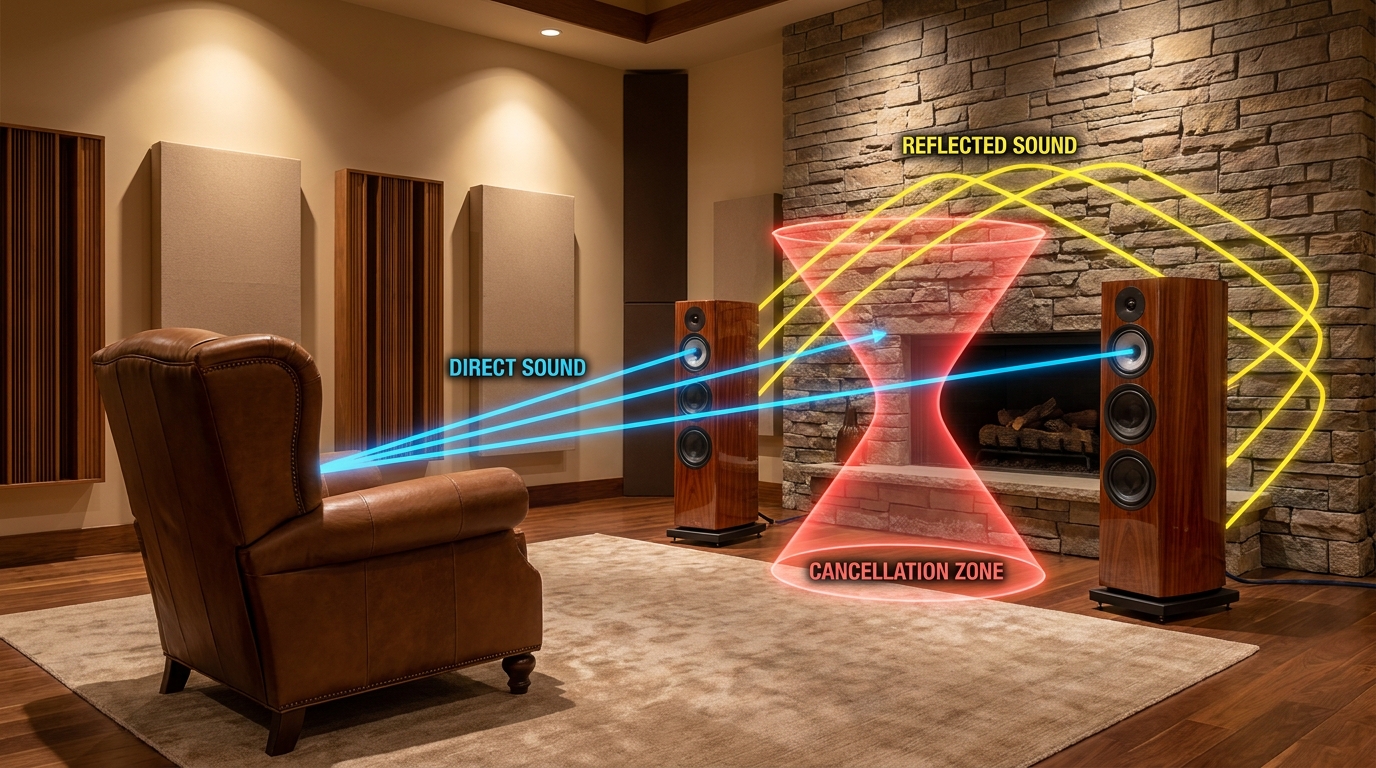
When a loudspeaker produces sound, some of that sound travels directly to your ears.
At the same time, some sound reflects from nearby room boundaries.
These boundaries include:
- The front wall behind the speakers
- Side walls
- The floor
- The ceiling
- Large furniture surfaces
Because reflected sound travels a longer distance, it arrives slightly later than the direct sound.
When the direct and reflected sound combine, they may either reinforce or cancel each other.
At specific frequencies, cancellation occurs.
This cancellation often appears as a deep dip in the measured frequency response.
In severe cases, these cancellations can remove a significant amount of acoustic energy.
The result is often audible and sometimes dramatic.
Why SBIR Happens
SBIR is fundamentally a timing problem.
Imagine a speaker positioned close to the front wall.
Some sound travels directly to the listening position.
Another portion travels backward, reflects from the wall, and then reaches the listener.
Because the reflected sound has travelled a greater distance, it arrives slightly later.
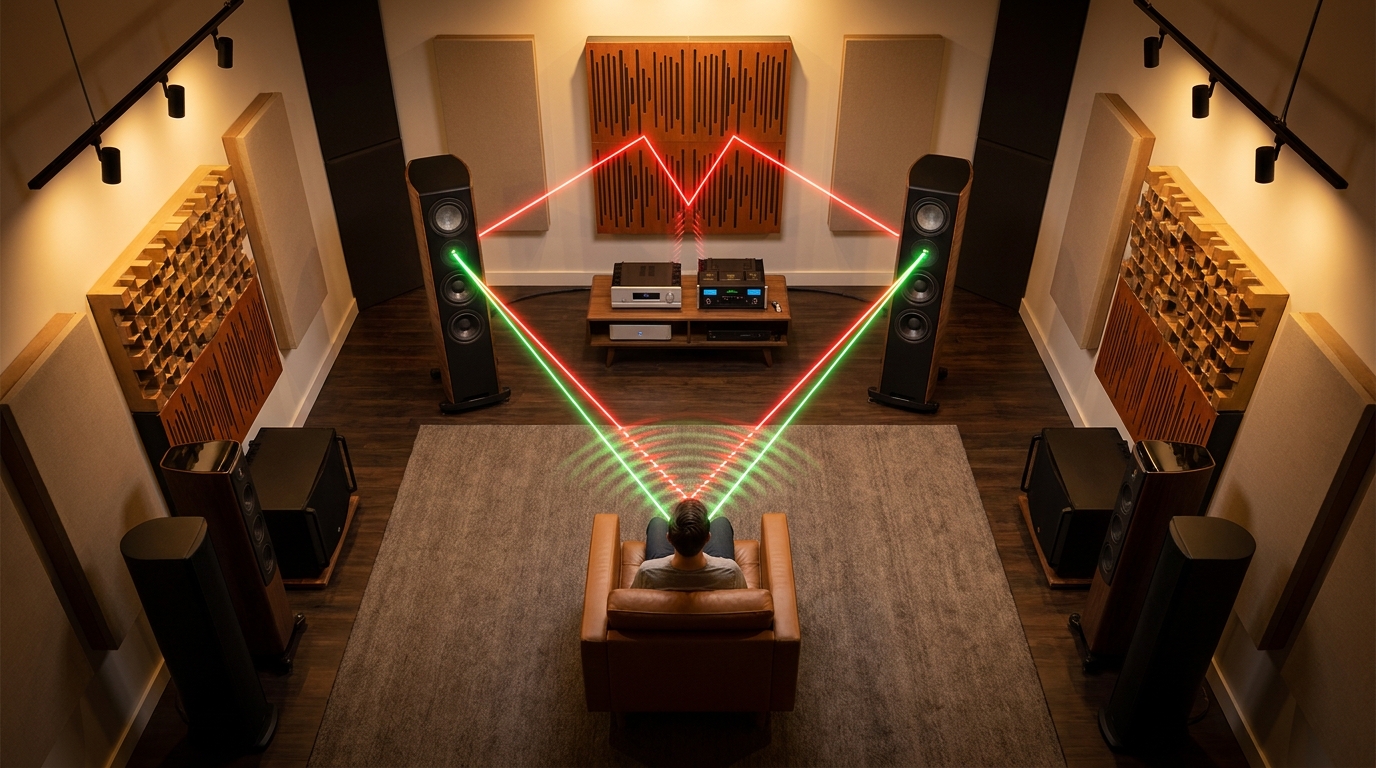
At certain frequencies, the delayed reflection arrives approximately half a wavelength behind the direct sound.
When this happens, destructive interference occurs.
The sound waves partially or completely cancel each other.
This creates a dip in the measured response.
The location of this cancellation is strongly influenced by the distance between the speaker and the boundary.
This is why moving a speaker by even 10–20 centimetres can sometimes produce surprisingly large changes in bass performance.
The room hasn't changed.
The timing relationship between the direct and reflected sound has.
Common Symptoms Of SBIR
Many listeners experiencing SBIR describe remarkably similar symptoms.
These include:
- Weak bass
- Missing punch
- Poor centre image focus
- Reduced soundstage depth
- Thin lower midrange
- Uneven tonal balance
- Lack of impact
- Vague imaging
One of the frustrating aspects of SBIR is that listeners often blame the speakers.
They assume:
- the speakers lack bass
- the amplifier lacks power
- the DAC sounds thin
- the room needs EQ
In reality, the room may simply be cancelling part of the speaker's output.
The speaker is producing the sound.
The room is removing it.
Why Expensive Speakers Still Suffer From SBIR
SBIR is governed by physics.
Physics does not care how much your speakers cost.
A $50,000 loudspeaker positioned poorly may suffer from exactly the same cancellation problems as a $1,000 loudspeaker.
This is one reason why experienced enthusiasts often spend significant time optimising placement before considering upgrades.
Speaker placement is free.
Yet placement changes frequently outperform expensive equipment changes.
This can be difficult to accept because buying equipment is often easier than moving furniture or rethinking room layout.
However, the room always has the final say.
How Speaker Distance From The Front Wall Affects SBIR
The distance between the speaker and the front wall is one of the strongest contributors to SBIR.
Consider a speaker positioned only 20cm from the front wall.
Reflections return very quickly.
This often shifts the cancellation higher in frequency.
Now imagine the same speaker positioned 80cm from the wall.
The timing relationship changes.
The cancellation frequency moves.
The entire tonal balance of the system may change.
This is why placement recommendations found online should always be treated as starting points rather than absolute rules.
Every room behaves differently.
Every loudspeaker interacts differently with the room.
Measurement and experimentation remain essential.
Practical Experiment
If your speakers are currently close to the front wall, try the following:
- Measure the current position.
- Move the speakers forward by 10cm.
- Measure again.
- Repeat several times.
You may discover that a severe cancellation becomes substantially less severe simply through placement optimisation.
AudioBro's RoomMatch tool can help you visualise optimal speaker positions for your specific room dimensions.
Side Walls, Floor Bounce, And Ceiling Reflections
Front wall interactions receive most of the attention, but SBIR is not limited to the wall behind the speaker.
Side walls also contribute.
Strong side-wall reflections can reduce imaging precision and alter tonal balance.
The floor creates another form of SBIR often called floor bounce.
Because the floor is usually close to the speaker and listener, cancellations often occur in the midbass and lower midrange.
Ceiling reflections can create similar problems, particularly in rooms with low ceilings.
Every boundary contributes to the overall acoustic picture.
This is one reason room optimisation should always consider the entire room rather than a single dimension. Tools like PhotoAcoustics can help you identify problematic reflection points by analysing a photo of your room.
Real-World Example: The 140Hz Dip
Imagine a pair of speakers positioned 35cm from the front wall.
A measurement reveals a deep dip around 140Hz.
The immediate assumption is often:
"My speakers don't have enough bass."
The owner may begin considering:
- a new amplifier
- new speakers
- room correction
- additional subwoofers
However, after moving the speakers an additional 20cm into the room, the dip becomes significantly shallower.
No equipment changed.
Only placement changed.
This is classic SBIR behaviour.
The lesson is simple:
Before upgrading equipment, verify whether the room is causing the problem.
How To Identify SBIR Using REW And A UMIK-1
The most reliable way to identify SBIR is through measurement.
Tools such as:
- Room EQ Wizard (REW)
- miniDSP UMIK-1
- AudioBro measurement workflows
can reveal cancellations that are difficult or impossible to diagnose by ear.
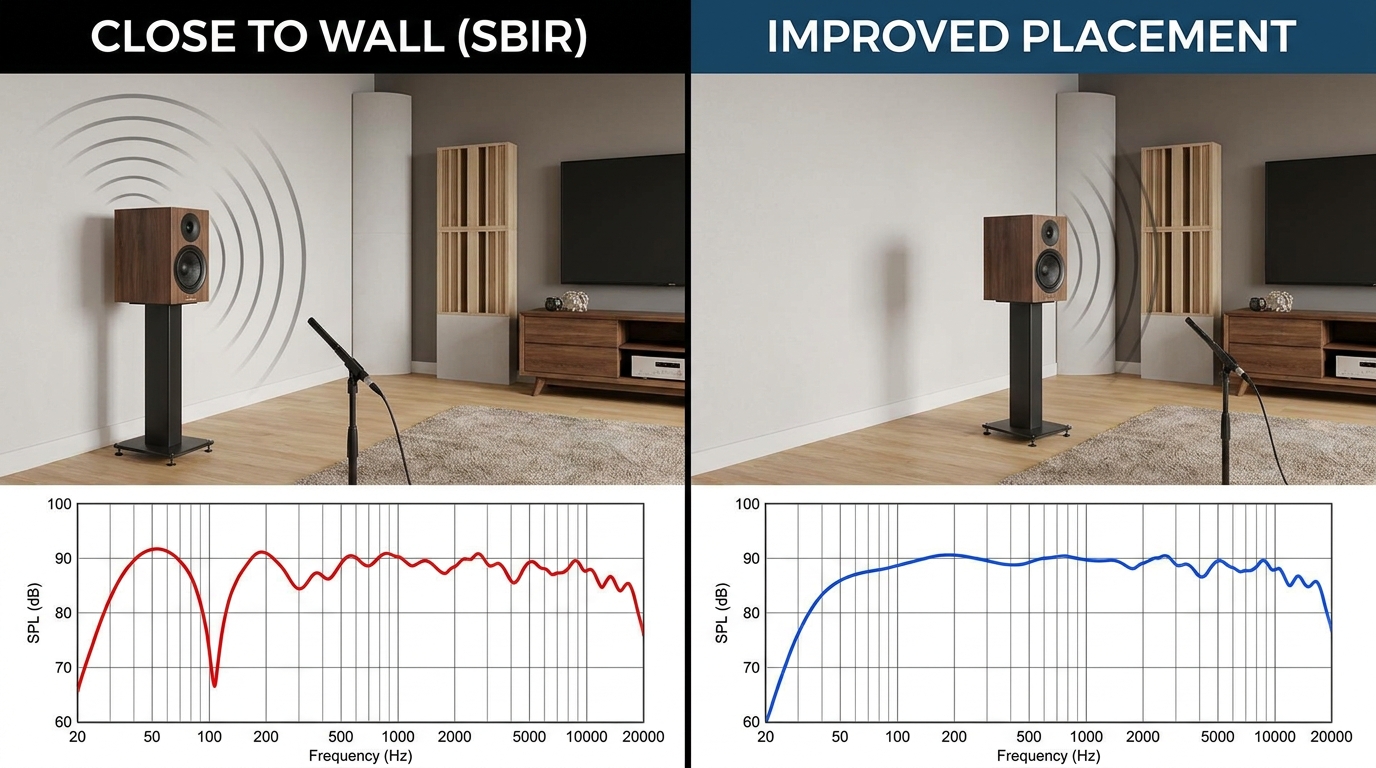
SBIR often appears as:
- narrow frequency response dips
- broad cancellations
- changes that shift as speakers move
One useful diagnostic technique is simple:
Measure.
Move the speaker.
Measure again.
If the dip moves significantly, SBIR is likely involved.
If the dip remains fixed, room modes may be the dominant factor.
This distinction is critical because the solutions are different.
If you have REW measurements, you can upload them directly to AudioBro for detailed frequency response analysis. AudioBro will help you identify whether you're dealing with SBIR, room modes, or both — and recommend specific next steps.
Why SBIR Is Often Confused With Room Modes
SBIR and room modes frequently produce similar-looking measurements.
Both can create:
- peaks
- dips
- uneven bass
However, they originate from different mechanisms.
Room modes are caused by room dimensions and standing waves.
SBIR is caused by reflections interacting with direct sound.
The distinction matters because the solutions differ.
Room mode solutions may include:
- multiple subwoofers
- seating changes
- bass trapping
- EQ
SBIR solutions often involve:
- moving speakers
- changing listening position
- front-wall absorption
- room layout changes
Correct diagnosis is essential.
Fixing the wrong problem wastes time and money.
For a deeper understanding of how REW shows you the problem and AudioBro explains what to do about it, see our companion guide.
Why EQ Usually Fails To Fix SBIR
One of the most common mistakes enthusiasts make is boosting an SBIR dip with EQ.
Unfortunately, this rarely works well.
SBIR is usually a cancellation problem.
The room is literally cancelling acoustic energy.
Adding additional energy with EQ often increases amplifier workload without substantially improving the response.
The room simply continues cancelling the sound.
This is why placement optimisation is almost always the first recommendation.
You cannot reliably EQ your way out of a geometry problem.
If you want to understand how your EQ settings interact with your room, AudioBro's Room EQ Wizard vs AudioBro comparison explains how measurement-based tools can guide better decisions.
How To Reduce SBIR
There is no universal solution.
However, several approaches are commonly effective.
Move The Speakers
Usually the highest-value change.
Small movements can produce large improvements.
Move The Listening Position
Sometimes moving the listener is easier than moving the speakers.
Use Thick Front-Wall Absorption
Substantial absorption behind speakers can reduce reflections.
Thin decorative panels are rarely effective at low frequencies.
Optimise Subwoofer Integration
Subwoofers may help smooth low-frequency response, although they do not eliminate SBIR entirely. AudioBro's Tune My Sub tool can help you optimise subwoofer crossover and placement.
Measure And Verify
Always verify improvements using measurements.
Assumptions are unreliable.
Evidence wins.
SBIR In Stereo Systems
In stereo systems, SBIR often manifests as:
- reduced soundstage depth
- weak centre image
- lower-midrange cancellations
- tonal imbalance
Because imaging is critical in two-channel listening, placement optimisation is particularly important.
Many listeners are surprised by how dramatically imaging improves after resolving major SBIR issues.
AudioBro's Fix My Stereo journey walks you through the full optimisation process, from initial measurement to verified improvement.
SBIR In Home Theater Systems
Home theater systems face additional challenges.
Multiple speakers interact with multiple boundaries.
Centre speakers placed inside cabinets are especially vulnerable.
Common issues include:
- poor dialogue clarity
- uneven front-stage integration
- weak impact
- tonal inconsistency across seats
Home theater rooms often benefit from careful placement, acoustic treatment, and measurement-based optimisation.
If you want to understand how your measurement files work with AudioBro, learn what an MDAT file is and how to export one from REW.
Final Thoughts
Many disappointing systems are not limited by equipment.
They are limited by the interaction between the speakers and the room.
SBIR is one of the most common examples.
Before spending money on upgrades, spend time understanding what your room is doing.
Measure.
Experiment.
Verify.
Fix the right problem first.
Better sound rarely starts with better gear.
It usually starts with better decisions.