
What Is A Room Mode? Understanding Standing Waves, Bass Nulls And Room Resonances
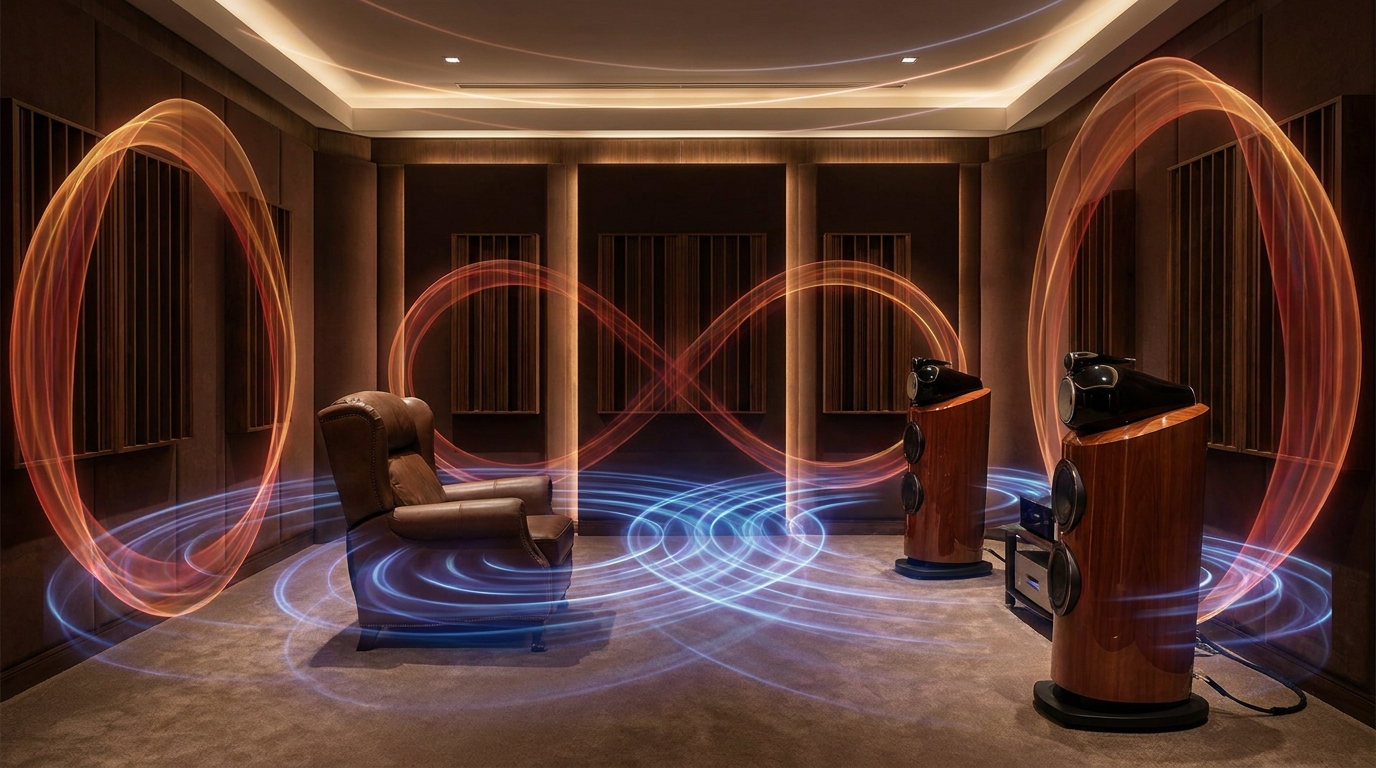
You've Upgraded Everything. So Why Is The Bass Still Bad?
You've bought the speakers.
You've added a subwoofer.
Maybe you've upgraded your amplifier, DAC, or even added room correction.
Yet something still isn't right.
Some bass notes shake the room.
Others seem to disappear entirely.
Move a metre to the left and the bass becomes overwhelming.
Move back to your main seat and suddenly there's almost no impact at all.
If this sounds familiar, you're almost certainly experiencing room modes.
Room modes are one of the biggest reasons expensive systems underperform in domestic rooms.
They're also one of the least understood.
The good news?
Once you understand what room modes are and how they behave, many bass problems become much easier to diagnose and improve.
What Is A Room Mode?
A room mode is a natural resonance created by the dimensions of your room.
Every enclosed space has resonant frequencies.
When bass frequencies produced by your speakers or subwoofers match these resonances, sound energy builds up in certain locations and cancels in others.
This creates an uneven bass response throughout the room.
In practical terms, room modes cause:
- Bass peaks
- Bass nulls
- Boomy bass
- Missing bass
- Inconsistent bass between seats
The room itself becomes part of the playback system.
This is why the same speakers can sound dramatically different in two different rooms.
Why Room Modes Happen
Bass frequencies have long wavelengths.
For example:
- 20Hz has a wavelength of approximately 17 metres.
- 40Hz has a wavelength of approximately 8.5 metres.
- 80Hz has a wavelength of approximately 4.3 metres.
In most domestic rooms, these wavelengths interact strongly with the room boundaries.
Sound reflects from:
- Front walls
- Rear walls
- Side walls
- Floor
- Ceiling
When these reflections combine, standing waves form.
Standing waves create areas of:
Reinforcement
Bass becomes louder.
Cancellation
Bass becomes weaker or disappears completely.
This is why one listening position may sound excellent while another sounds terrible.
Understanding Standing Waves
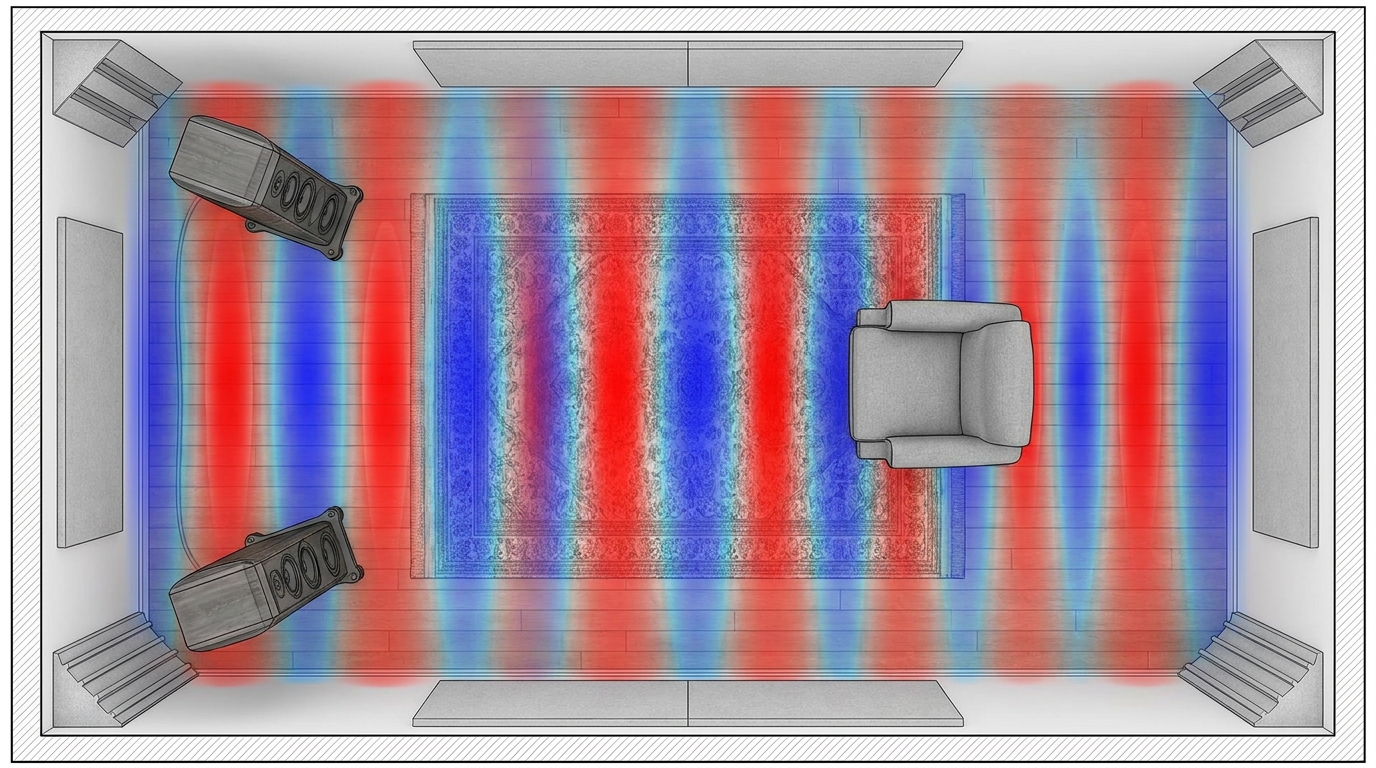
A standing wave occurs when sound waves repeatedly bounce between room boundaries.
At specific frequencies, these reflections reinforce themselves.
The energy effectively becomes trapped within the room.
Some locations experience maximum energy.
Other locations experience severe cancellation.
This is why moving only a small distance within the room can dramatically change bass performance.
Standing waves are unavoidable.
Every room has them.
The goal is not elimination.
The goal is management.
The Three Types Of Room Modes
Axial Modes
Axial modes occur between two opposing surfaces.
Examples include:
- Front wall to rear wall
- Side wall to side wall
- Floor to ceiling
These are usually the strongest and most audible room modes.
Because they involve only two boundaries, they contain the highest energy.
Most problematic bass issues are dominated by axial modes.
Tangential Modes
Tangential modes involve four room surfaces simultaneously.
Examples include:
- Front wall + rear wall + both side walls
Tangential modes generally contain less energy than axial modes.
However, they still contribute significantly to overall room behaviour.
Oblique Modes
Oblique modes involve all six room surfaces.
Examples include:
- Front wall
- Rear wall
- Side walls
- Floor
- Ceiling
These modes usually contain the least energy.
Nevertheless, they remain part of the overall acoustic picture.
Common Symptoms Of Room Modes
Room modes often reveal themselves through familiar complaints.
"The bass is boomy."
Strong room resonances exaggerate certain frequencies.
"Some notes disappear."
Bass nulls created by cancellations remove specific frequencies.
"Bass sounds different in every seat."
Different positions experience different modal behaviour.
"My subwoofer sounds powerful in one corner but weak elsewhere."
Classic modal behaviour.
"The system lacks impact."
The listening position may sit directly inside a modal null.
What Is A Bass Null?
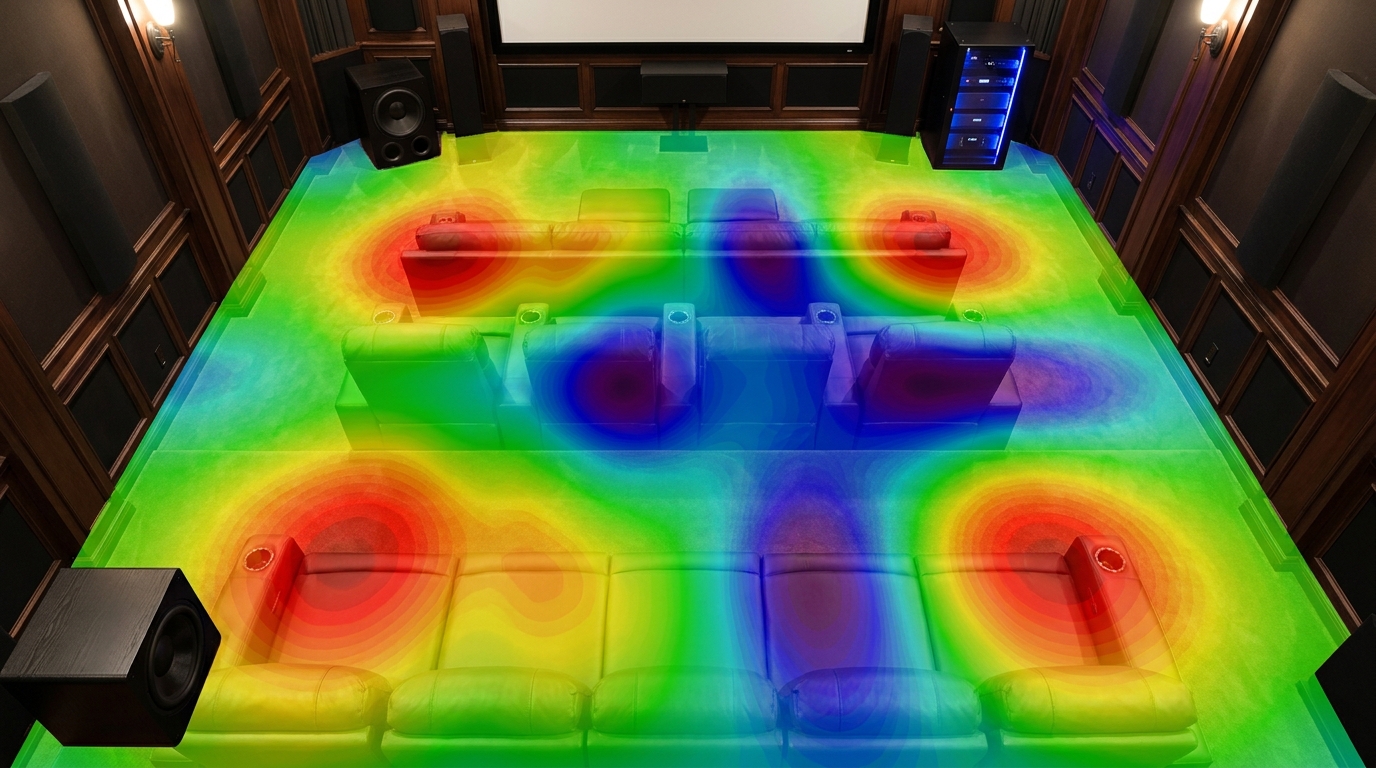
A bass null is an area where sound waves cancel each other.
Nulls can be severe.
It's not uncommon to see:
- 10dB cancellations
- 20dB cancellations
- Even larger cancellations in difficult rooms
This means substantial amounts of bass energy never reach the listener.
Many enthusiasts incorrectly assume:
"My speakers don't produce enough bass."
In reality, the room is cancelling the bass before it reaches their ears.
Why Sitting In The Centre Of The Room Is Often A Bad Idea
One of the most common mistakes in audio is placing the listening position exactly in the centre of the room.
Unfortunately, this location frequently coincides with strong modal cancellations.
The result:
- Weak bass
- Missing impact
- Poor consistency
As a starting point, many enthusiasts avoid placing the listening position directly at:
50% room length.
Small adjustments can produce surprisingly large improvements.
Why Expensive Equipment Cannot Fix Room Modes
Room modes are caused by room geometry.
Changing:
- DACs
- Amplifiers
- Cables
- Streamers
will not eliminate them.
The room does not care how much your equipment costs.
This is why room optimisation frequently delivers larger improvements than equipment upgrades.
Many enthusiasts spend thousands chasing problems that are fundamentally acoustic.
AudioBro's Fix My Room and Design My Room tools help you identify and address these acoustic problems before spending on equipment upgrades.
How To Identify Room Modes Using REW And A UMIK-1
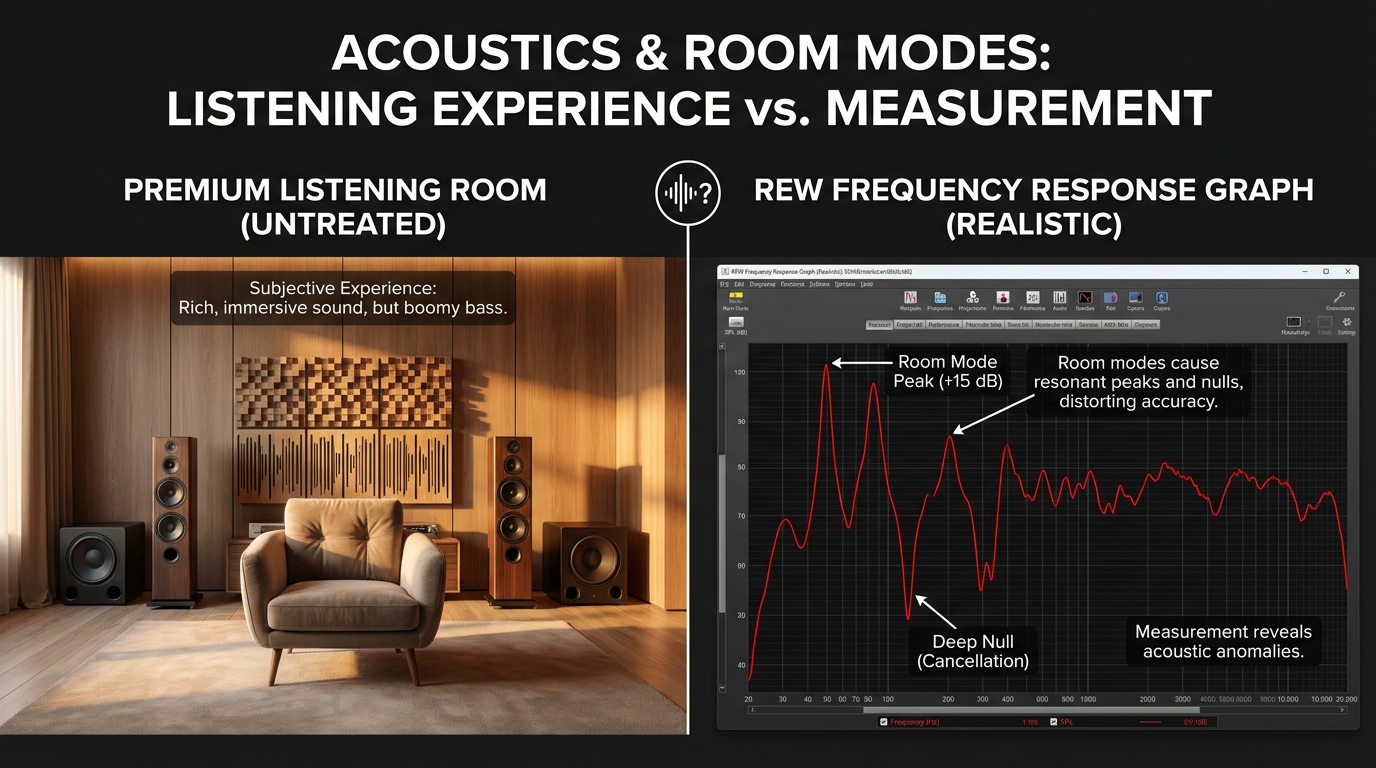
Measurements are essential.
Tools such as:
make room modes visible.
Typical indicators include:
- Large bass peaks
- Deep bass nulls
- Significant seat-to-seat variation
- Long decay times in waterfall graphs
Measurements allow you to identify:
- Problem frequencies
- Severity
- Likely causes
- Potential solutions
Without measurements, diagnosis often becomes guesswork.
Learn more: REW Shows You The Problem. AudioBro Explains What To Do About It.
See also: What Is An MDAT File? The REW Measurement Format Explained
Room Modes vs SBIR
Room modes and SBIR are frequently confused.
Both can produce peaks and dips.
However, they originate from different mechanisms.
Room Modes
Caused by standing waves and room dimensions.
SBIR
Caused by reflections interacting with direct sound.
Correct diagnosis is critical because solutions differ.
Learn more in our guide:
What Is SBIR? Speaker Boundary Interference Explained
How To Reduce Room Modes
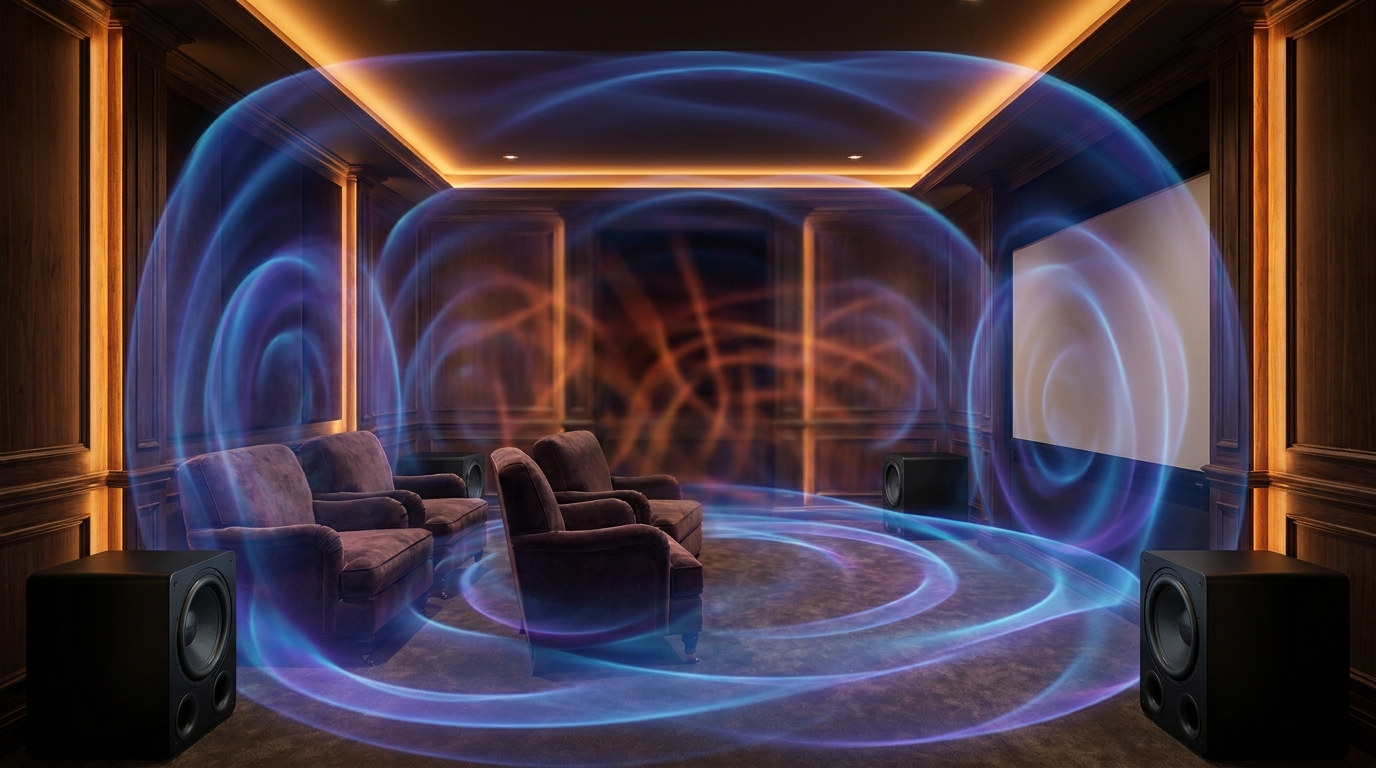
There is no single solution.
Most successful rooms use multiple strategies.
Optimise Speaker Placement
Changing speaker positions alters modal excitation.
Small movements matter.
Optimise Listening Position
Moving the seat often produces dramatic improvements.
Use Multiple Subwoofers
Multiple subwoofers frequently provide the single biggest improvement in bass consistency.
Dual, triple, and quad subwoofer systems help distribute modal energy more evenly.
Learn more: Why You (Probably) Need Two Subwoofers
Add Bass Trapping
Bass traps absorb low-frequency energy and reduce modal ringing.
Thicker traps generally perform better.
Optimise Your Subwoofer
Subwoofer crossover, phase, and level all interact with room modes. AudioBro's Tune My Sub workflow helps you find the right settings for your room.
Use Equalisation Carefully
EQ can reduce peaks.
EQ is much less effective at correcting deep nulls.
Measure, Adjust, Verify
Always verify changes using measurements.
Never assume.
Why Waterfall Graphs Matter
Frequency response only tells part of the story.
Room modes also affect decay.
Excessive modal ringing often appears in waterfall graphs.
Long decay times can create:
- Muddy bass
- Slow bass
- Reduced clarity
Understanding both frequency and time-domain behaviour is essential.
Frequently Asked Questions
What causes room modes?
Room dimensions and reflected low-frequency energy.
Can room modes be eliminated?
No. They can only be managed and reduced.
Are room modes always bad?
All rooms have modes. Problems occur when modal behaviour becomes excessive.
Can EQ fix room modes?
EQ can help reduce peaks but usually cannot fix severe nulls.
What is the best way to improve bass?
Optimised placement, multiple subwoofers, acoustic treatment, and measurements.
Do expensive speakers eliminate room modes?
No. Room modes affect all speakers regardless of price.
Why does bass disappear in certain seats?
Modal cancellations create bass nulls.
How do I measure room modes?
REW and a calibrated microphone such as the UMIK-1 are commonly used.
Ready To Improve Your Bass?
Understanding room modes is the first step.
The next step is identifying exactly how your room is affecting your system.
AudioBro can help you identify room modes, bass nulls, placement issues, and optimisation opportunities using measurements, room photographs, and guided analysis workflows.
Whether you're building a stereo system or a dedicated home theater, evidence-based optimisation almost always delivers bigger improvements than upgrading equipment alone.
Continue Your Optimisation Journey
- Fix My Room — Upload measurements or use guided analysis to diagnose and fix acoustic issues
- BassMap — Map bass response across your room and find the best subwoofer positions
- Design My Room — Get speaker placement and acoustic treatment recommendations for your room
Final Thoughts
Many disappointing systems are not limited by electronics.
They are limited by the room.
Room modes are one of the biggest reasons why.
Understanding how your room behaves allows you to make better decisions about:
- Speaker placement
- Seating position
- Subwoofer integration
- Acoustic treatment
- Calibration
Before upgrading equipment, measure your room.
The biggest improvement in your system may already be sitting around you.