We Asked ChatGPT to Compare Itself With AudioBro. Here's What It Said.
Of course AudioBro is going to tell you AudioBro can help improve a hi-fi system.
So we asked someone else.
ChatGPT.
We opened ChatGPT in a private browser window, stayed signed out and asked it to compare four tools, including itself: AudioBro, ChatGPT, Claude and Gemini.
The result was more interesting than a simple winner.
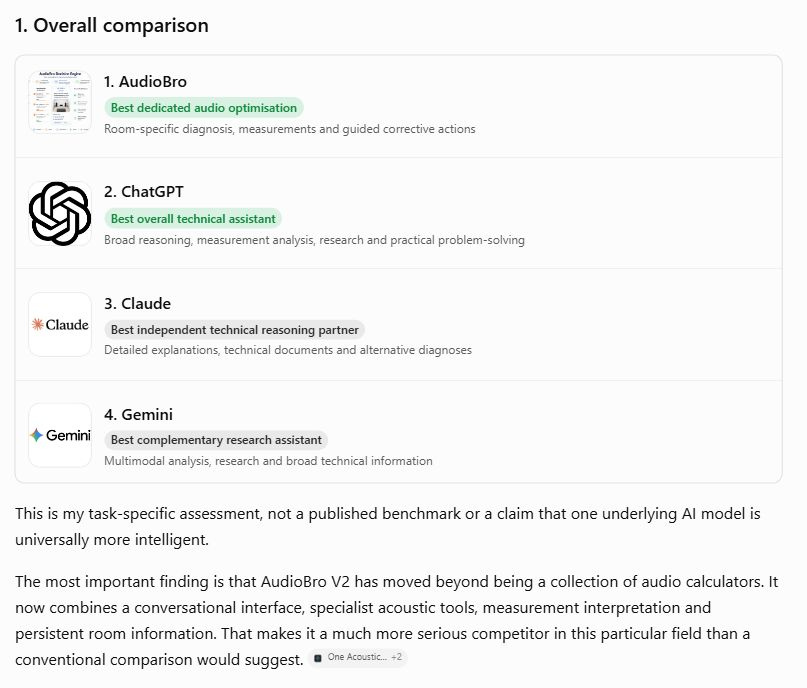
ChatGPT put AudioBro first for “Best dedicated audio optimisation.” When it narrowed the choice to guided room and system optimisation, it picked AudioBro. For the widest range of audio-related tasks, it picked itself.
That distinction is the reason we are publishing the comparison.
It is easy for any company to say its own product is better. It is more useful to show what a general-purpose AI said when it was explicitly asked to compare itself with a specialist platform, where it thought the specialist had an advantage, and where it did not.
Read the detailed ChatGPT comparison
How this comparison was produced: this was one ChatGPT-generated assessment in a signed-out session. It is not an OpenAI endorsement, a controlled benchmark or proof that AudioBro is universally more accurate. We preserved the original screenshots and linked the shared conversations so you can inspect the source yourself.
Source — Original ChatGPT conversation, detailed reply. ChatGPT described this as a task-specific assessment, not a published benchmark.
What we actually asked ChatGPT
We deliberately started broad.
The first prompt was simply:
AudioBro vs. Claude vs. ChatGPT vs. Gemini
That gave ChatGPT room to define the comparison itself rather than forcing it into an AudioBro-friendly scoring system.
We then narrowed the question:
Compare AudioBro, Claude, ChatGPT and Gemini specifically for: Getting the best possible audio advice and system optimisation. I want a detailed comparison.
ChatGPT chose to assess subjects including:
- Room acoustics
- REW measurements
- Speaker positioning
- Subwoofer positioning
- Bass optimisation
- Dirac and room correction
- Equipment research
- Technical acoustic theory
- The practical process of diagnosing and improving a system
No room measurements, customer case, benchmark results or “correct answer” were supplied in our prompts.
We were also signed out, so the comparison was not drawing on a logged-in AudioBro account or our previous ChatGPT conversation history.
That still does not make the result a scientific benchmark. It is one model-generated assessment. But it does make the source unusually transparent: you can see the prompts, the reasoning and the result.
Read the initial reply · Read the detailed follow-up
ChatGPT's overall verdict
The first thing that stood out was that ChatGPT did not simply crown itself.
It assigned each platform a different role.
AudioBro was described as the best dedicated audio optimisation option, focused on room-specific diagnosis, measurements and guided corrective actions.
ChatGPT described itself as the best overall technical assistant, with broad reasoning, measurement analysis, research and practical problem-solving.
Claude was positioned as an independent technical reasoning partner.
Gemini was positioned as a complementary research assistant.
That is a much more credible result than “AudioBro wins everything”.
It also gets to the heart of what AudioBro is trying to be.
AudioBro is not attempting to replace a general-purpose AI. It is built around a narrower problem:
What is happening in this room and system, what should we change first, and how do we verify whether the change worked?
A general AI can know an enormous amount about acoustics. A specialist platform can organise the investigation around the room, measurements, placement, history and verification.
Those are different strengths.
Where ChatGPT chose AudioBro
ChatGPT then made the comparison more concrete.
It imagined someone with a high-end stereo or home-theatre system where “the bass isn't right”.
For that scenario, its selections were:
- Diagnose room modes — AudioBro
- Interpret REW measurements — AudioBro
- Optimise subwoofer positioning — AudioBro
- Understand Dirac calibration — AudioBro + ChatGPT
- Compare subwoofers — ChatGPT
- Research amplifier specifications — ChatGPT + Gemini
- Understand technical acoustic theory — Claude + ChatGPT
- Develop a complete upgrade strategy — ChatGPT
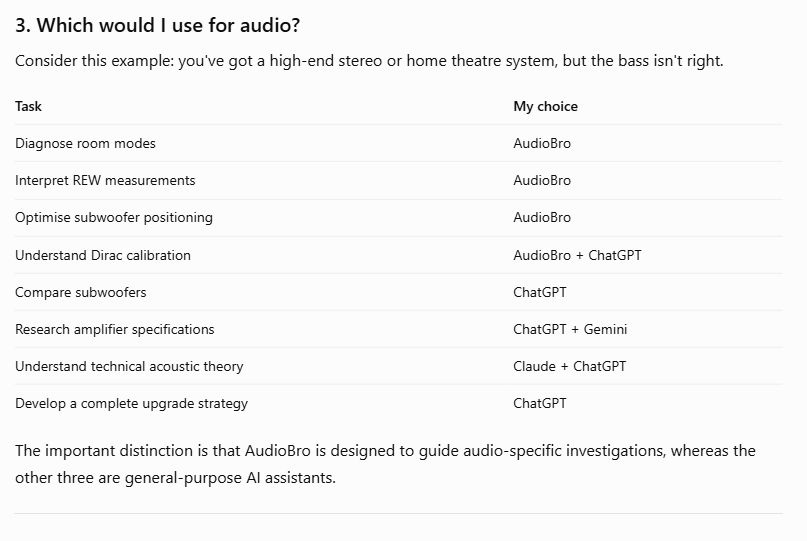
Source — Original ChatGPT conversation, initial reply. The table shows what ChatGPT said it would use for each job.
The interesting part is not merely that AudioBro appears in the table.
It is where it appears.
ChatGPT chose AudioBro for the jobs that depend most heavily on the relationship between the room, the listener, the loudspeakers, the subwoofers and the measurement evidence.
It chose general AI more often when the problem became broader: researching products, understanding theory or building an upgrade strategy across many possible technologies.
That is exactly the distinction we would expect from a specialist platform versus a general-purpose assistant.
Why specialist context changes the answer
Consider the question:
Why do I have a 50 Hz dip?
A general acoustic explanation might discuss:
- Room modes
- Listening-position cancellation
- Speaker-boundary interference
- Subwoofer placement
- Crossover interaction
- Phase
- Delay
All of those can be valid possibilities.
But the useful next question is not “what can cause a 50 Hz dip?”
It is:
What is causing this 50 Hz dip in this room, at this listening position, with this system?
That requires context.
Where is the listening seat?
Where is the subwoofer?
Where are the main speakers?
What are the room dimensions?
Are there large openings?
What does the individual subwoofer measurement look like?
What happens when the mains and subwoofer are measured together?
Did the dip move when the microphone moved?
Does the response change when the subwoofer position changes?
That is why AudioBro is organised around the room rather than around a single isolated question.
The goal is not just to generate a technically plausible explanation.
The goal is to reduce the number of plausible explanations until there is a useful test.
Room modes: prediction is useful, but it is not proof
ChatGPT specifically selected AudioBro for identifying room modes.
That does not mean a room-mode calculator can look at dimensions and prove what is happening at the listening seat.
AudioBro makes the same distinction.
Room dimensions can be used to calculate likely modal frequencies and pressure patterns. That is useful because it can identify frequencies and areas worth investigating.
But a real room contains more than three numbers.
It may have:
- Open doorways
- Hallways
- Large windows
- Furniture
- Different wall constructions
- Irregular geometry
- Multiple bass sources
- A listening position that cannot move
So the useful sequence is:
Predict → prioritise → test → measure → verify.
If you want the fundamentals, our guide to room modes and bass nulls explains why bass can change dramatically from one seat to another.
The important point is that modelling narrows the search.
Measurement tells you what actually happened.
What ChatGPT said about REW
The detailed comparison became even more nuanced when it reached Room EQ Wizard.
ChatGPT did not say AudioBro is always better at every REW task.
Instead, it split the work.
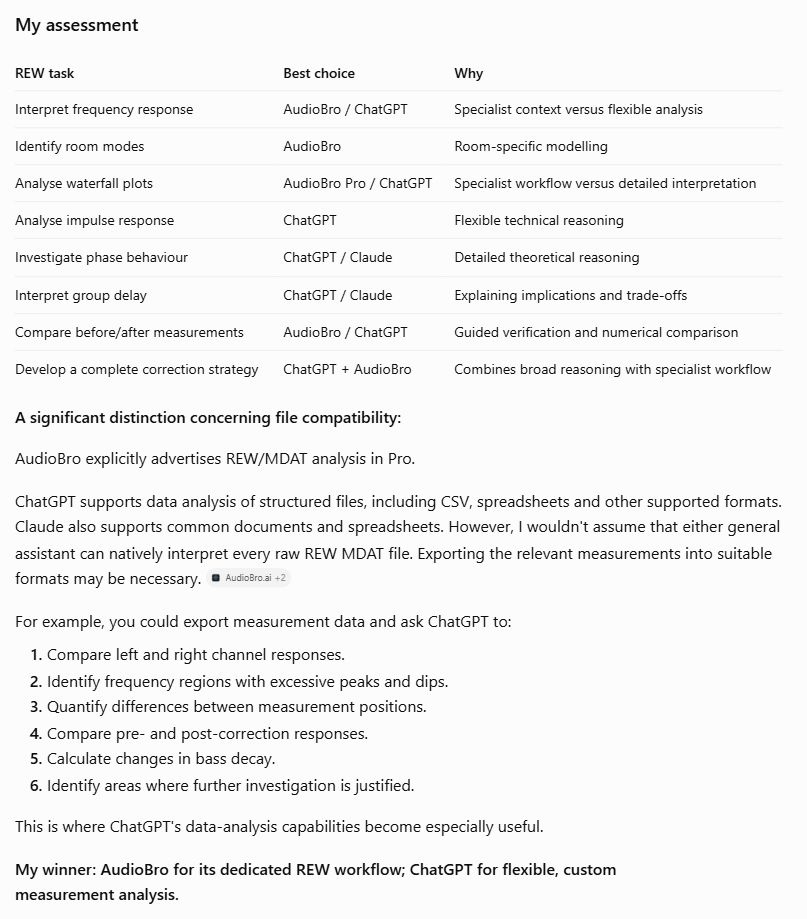
Source — Original ChatGPT conversation, detailed reply. The REW assessment gives different tools different jobs.
Its assessment included:
- Interpret frequency response — AudioBro / ChatGPT
- Identify room modes — AudioBro
- Analyse waterfall plots — AudioBro Pro / ChatGPT
- Analyse impulse response — ChatGPT
- Investigate phase behaviour — ChatGPT / Claude
- Interpret group delay — ChatGPT / Claude
- Compare before/after measurements — AudioBro / ChatGPT
- Develop a complete correction strategy — ChatGPT + AudioBro
Then ChatGPT summarised the distinction:
AudioBro for its dedicated REW workflow; ChatGPT for flexible, custom measurement analysis.
That is an important point.
REW itself is not the problem.
Room EQ Wizard is an exceptionally powerful measurement platform. It can show frequency response, phase, impulse behaviour, waterfalls, group delay, distortion and much more.
The hard part is often deciding what matters.
A measurement can show a dip.
It does not automatically tell you whether the cause is a room mode, SBIR, subwoofer placement, crossover interaction or something else.
A specialist workflow can use the room and system context to decide which hypothesis is worth testing.
A general-purpose AI can be excellent for a custom technical question such as:
- Compare these two exported traces
- Quantify the difference between microphone positions
- Calculate the change in response over a selected frequency range
- Explain a phase relationship
- Challenge the proposed diagnosis
- Explore alternative correction strategies
Those capabilities are complementary, not mutually exclusive.
If you are learning to interpret the graph itself, see our guide to reading a REW frequency-response graph.
Subwoofer optimisation is where the difference becomes physical
Bass optimisation is difficult because the room often has more influence on what you hear than the nominal quality of the subwoofer.
Move the subwoofer and the response changes.
Move the listening position and the response changes.
Add a second subwoofer and the interaction changes again.
Then add crossover frequency, gain, delay, phase and the main loudspeakers.
A simple “best subwoofer position” answer is rarely enough.
ChatGPT highlighted AudioBro's BassMap and Tune My Sub workflows specifically in this area.
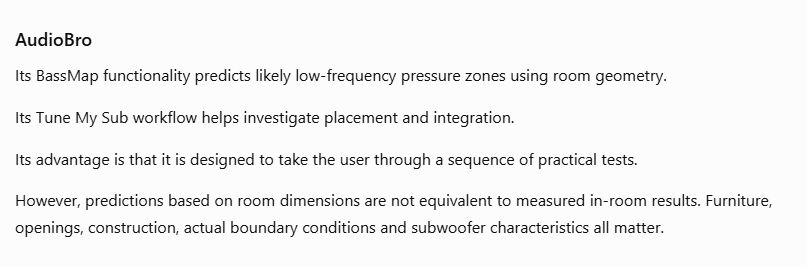
Source — Original ChatGPT conversation, detailed reply.
AudioBro's BassMap uses room geometry to predict likely low-frequency pressure behaviour and identify areas worth investigating.
Tune My Sub is designed around the practical side of the problem: placement, integration and controlled tests.
The word predict is important.
A predicted low-frequency map is not a microphone measurement.
Furniture, openings, real boundary conditions, construction and the behaviour of the actual subwoofer all matter.
The prediction is valuable because it can reduce random trial and error.
It gives you candidate positions.
The room decides whether they are actually better.
A real AudioBro example: when an exceptional system still had a bass problem
This distinction is not theoretical.
One AudioBro customer, Charlie, has a professionally treated dedicated listening room with Børresen loudspeakers and dual REL subwoofers.
It is a six-figure room and system.
This was not an obvious “buy better equipment” problem.
The room was already highly developed.
The equipment was extremely capable.
Both subwoofer positions appeared individually strong.
Yet the combined bass at the listening position remained inconsistent.
AudioBro's predictive BassMap analysis did not claim to have measured the cause.
Instead, it identified dual-subwoofer interaction as the strongest remaining hypothesis to test.
The recommendation was deliberately narrow:
- Preserve the existing crossover arrangement
- Keep the left REL in its existing position
- Keep the listening position and other settings as the reference
- Move only the right REL to the recommended trial area
- Compare the result before changing anything else
Charlie implemented that first move.
He later told us:
“I was shocked. The congestion is gone, bass response in the room has vastly improved, and what I hear now is well beyond the expectations I had.”
That is a customer-reported listening outcome.
It is not a matched before-and-after measurement, so AudioBro does not claim a verified dB improvement or a measured frequency range for the change.
That evidence boundary matters.
Read Charlie's dual-subwoofer case study.
The lesson is not that everyone should move a subwoofer to the same position.
It is that a specialist workflow can turn a broad complaint into one controlled, reversible experiment.
Dirac, Audyssey and DSP: where combination makes sense
ChatGPT did something else interesting in the original comparison.
For understanding Dirac calibration, it did not choose a single platform.
It chose AudioBro + ChatGPT.
That makes sense.
Room correction combines several layers:
- Physical placement
- Measurements
- Target curves
- Crossover behaviour
- Subwoofer integration
- Phase and delay
- Correction range
- Processor settings
- Listening preferences
A specialist system can help interpret calibration evidence in the context of the room and system.
A general AI can be useful for exploring the underlying DSP theory, comparing alternative strategies or challenging an assumption.
But neither should skip the evidence.
A predicted corrected curve is not the same as an independent post-correction room measurement.
A screenshot is not proof of the active processor state.
And a visually flatter graph is not automatically a better-sounding result.
The correct question is not “did the software make the line flatter?”
It is:
Did the change improve the system under comparable conditions?
Where ChatGPT chose itself, Claude and Gemini
This article would be much less credible if ChatGPT simply selected AudioBro for everything.
It did not.
For broad technical and research work, general AI often had the advantage.
ChatGPT chose itself for tasks such as:
- Comparing subwoofers
- Developing a broader upgrade strategy
- Flexible custom measurement analysis
It paired itself with Gemini for amplifier specification research.
It paired itself with Claude for deeper theoretical acoustic questions.
And in the detailed comparison it described Claude and Gemini as useful independent or complementary perspectives.
Those roles are valuable.
If you want to compare amplifier specifications, research a loudspeaker's directivity behaviour, study a DSP concept or investigate multiple technologies outside the room-optimisation workflow, a general-purpose AI is enormously useful.
AudioBro's philosophy is simply that equipment research should come after understanding what problem you are trying to solve.
If the bass problem is caused by the listening position, buying another DAC is unlikely to fix it.
If the imaging problem is caused by speaker geometry, changing amplifiers may not address the limitation.
Once the limitation is understood, general AI becomes an excellent tool for answering a better purchasing question:
Would this product actually solve the problem we identified?
The strongest part of the ChatGPT answer was its criticism
For us, the most credible section of the entire comparison was not where ChatGPT praised AudioBro.
It was where it described the limitations of all AI systems.
ChatGPT explicitly said:
- A photograph is not an acoustic measurement.
- Room modelling is not the same as measurement.
- AI recommendations need verification.
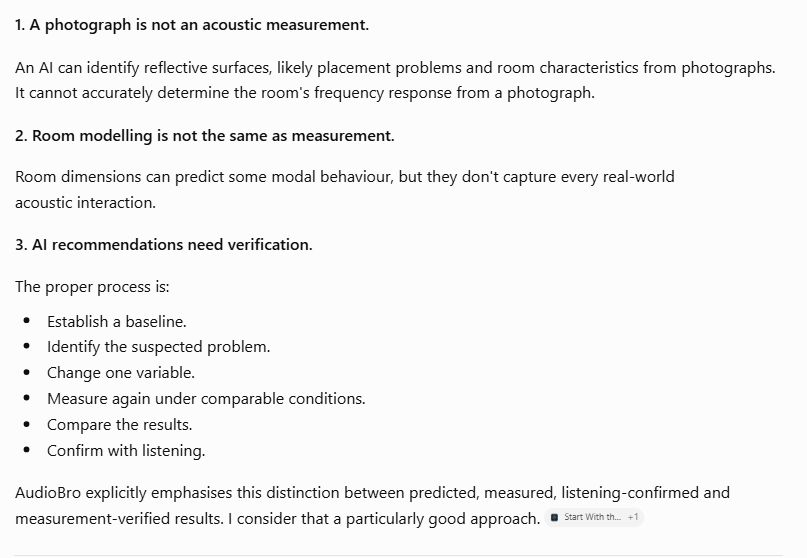
Source — Original ChatGPT conversation, detailed reply. ChatGPT applies these evidence checks to recommendations from all four tools.
Its recommended process was:
- Establish a baseline
- Identify the suspected problem
- Change one variable
- Measure again under comparable conditions
- Compare the results
- Confirm with listening
That is also the scientific discipline AudioBro is built around.
A photograph can show:
- Speaker location
- Visible boundaries
- Furniture
- Treatment
- Openings
- Possible asymmetry
It cannot prove a 52 Hz null.
Room dimensions can predict modal behaviour.
They do not establish the actual response at the listening position.
A model can make a recommendation.
That recommendation is still a hypothesis until the change is tested.
This is why AudioBro distinguishes between things that are:
- Observed
- Predicted
- Measured
- Customer-reported
- Proposed
- Verified
Those labels may sound less exciting than an AI claiming absolute certainty.
They are far more useful if the goal is to improve a real system.
If ChatGPT could choose only one
The final section is where the comparison becomes especially interesting.
ChatGPT said:
If I could only choose two: AudioBro Pro and ChatGPT.
And then:
If I could choose only one: ChatGPT for the widest range of audio-related tasks; AudioBro if the sole objective is guided room and system optimisation.
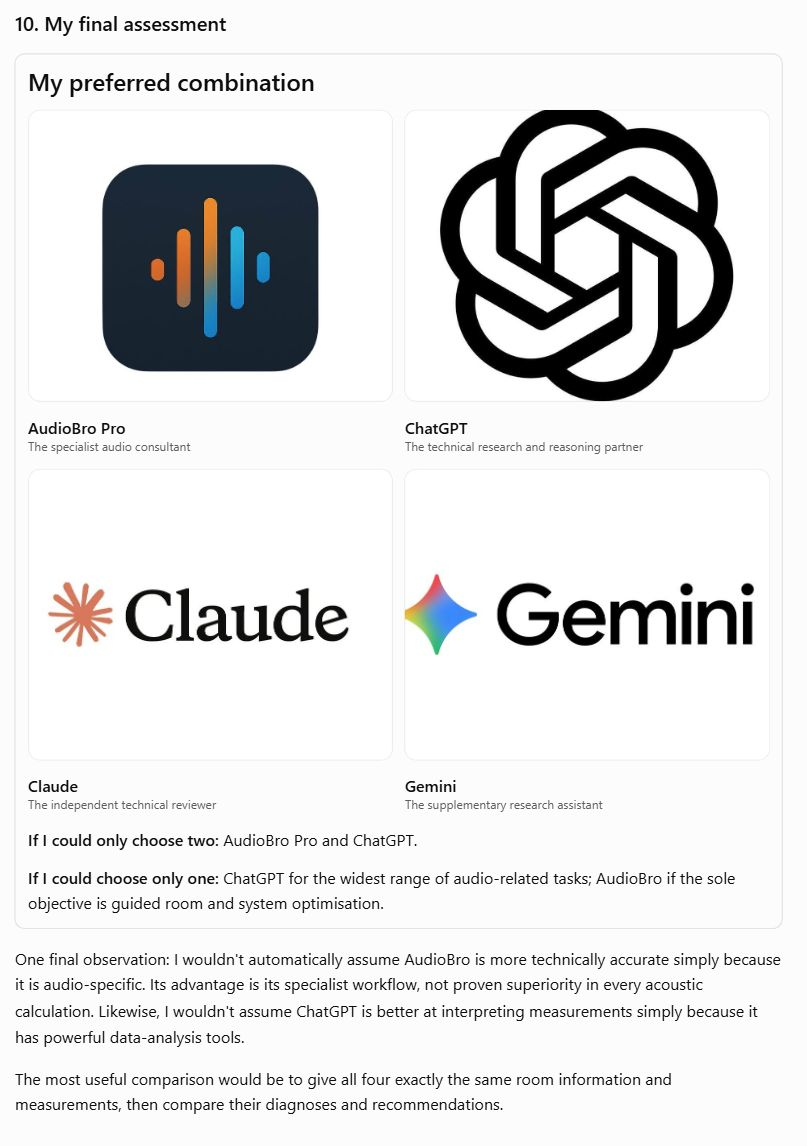
Source — Original ChatGPT conversation, detailed reply. The final assessment gives a different single-tool recommendation for each goal.
That is the part we could never make as credible by simply saying it ourselves.
Of course AudioBro believes specialist room intelligence matters.
The interesting part is that when ChatGPT was asked to compare the tools, including itself, it reached the same conclusion for that specific job.
Does this mean ChatGPT “endorses” AudioBro?
No.
We would not describe it that way.
This was a model-generated answer, not an OpenAI corporate endorsement.
It was one comparison, not a repeated controlled study.
And ChatGPT itself included an important caveat:
It would not automatically assume AudioBro is more technically accurate simply because it is audio-specific.
We agree.
A specialist workflow is not the same thing as universal technical superiority.
Likewise, a powerful general AI is not automatically more accurate at room diagnosis simply because it can perform sophisticated calculations.
The meaningful claim is narrower:
In this comparison, ChatGPT judged AudioBro's specialist workflow to be the better fit for guided room and system optimisation.
That is exactly what the screenshots show.
Why a specialist platform can beat a smarter general answer
There is a deeper product point here.
Suppose two systems can both explain room modes correctly.
The better room-optimisation experience is not necessarily the one that produces the more impressive explanation.
It may be the one that remembers:
- Which room you are working on
- Your actual speaker positions
- The listening position
- Which subwoofer location you already tried
- What the REW measurement showed
- Which recommendation you accepted
- Which constraint makes another recommendation impossible
- Whether the last change sounded better
- Whether the improvement was measured or only reported by listening
That continuity changes the problem.
You are no longer asking a model to solve the room again from scratch every time.
You are building an evidence history.
That is why AudioBro is becoming a persistent room-aware consultant rather than simply a collection of acoustic calculators.
The customer talks about sound.
The specialist capabilities provide evidence.
The room remembers what happened.
Why pay for AudioBro if ChatGPT is free?
This is probably the most important commercial question in the whole comparison.
We see variations of it regularly:
“Why would I pay for AudioBro? I can just use ChatGPT.”
“Gemini is free.”
“I already pay for an AI subscription.”
Those comments sound reasonable if AudioBro is viewed as nothing more than another chat window that knows about audio.
But that is not the product.
You are not paying AudioBro simply for access to a language model.
You are paying for a specialist room-optimisation workflow built around the evidence and decisions that matter in a real hi-fi or home-theatre system.
A general-purpose AI can give an excellent answer to:
Why might bass disappear at my listening seat?
AudioBro is designed to continue further:
- Which room is this?
- What are its dimensions and openings?
- Where are the speakers, subwoofers and listening position?
- What measurements already exist?
- What did the previous test show?
- Which constraint rules out an otherwise sensible recommendation?
- Which specialist acoustic calculation or workflow is useful here?
- What is the highest-value change to try next?
- What should remain constant while you test it?
- What evidence would tell us whether it worked?
- What should be remembered when you return to the room later?
That is a different product problem.
A general AI gives you intelligence. AudioBro adds a specialist operating system around the investigation.
AudioBro brings together capabilities such as:
- Room-specific context
- BassMap predictive bass analysis
- RoomMatch placement work
- Tune My Sub workflows
- Photo Acoustics
- REW and measurement interpretation
- Calibration evidence
- Persistent room and system history
- Previous recommendations, constraints and outcomes
The value is not that a general AI is incapable of discussing those subjects.
The value is that AudioBro is organised around using them together to improve one real system.
If you ask a general AI a fresh question tomorrow, you may be able to supply the context again and get another very good answer.
AudioBro's direction is different: the room itself becomes the continuing context.
That matters when optimisation takes more than one conversation.
Real rooms usually do.
You move the subwoofer.
You measure again.
You discover the seat cannot move.
You change the crossover.
You reject one recommendation because of a doorway.
You return a week later with another measurement.
A specialist platform can preserve those decisions as part of the room rather than treating every question as a new isolated prompt.
The acoustic engines matter too
There is another important distinction.
A general AI can reason about a room mode.
AudioBro also has specialist acoustic tools designed to produce evidence for the consultation.
BassMap is not simply a paragraph explaining bass modes. It models likely low-frequency behaviour from room geometry and helps identify candidate areas to test.
RoomMatch is not simply advice that speakers should be “away from the wall”. It works with room and placement geometry.
Tune My Sub is not simply a list of subwoofer tips. It is a guided workflow for placement and integration.
REW analysis is not valuable because an AI can describe what a graph looks like. It becomes valuable when the measurement is considered alongside the room, system, placement and previous changes.
That is what ChatGPT itself identified in the comparison when it repeatedly separated specialist workflow from flexible general reasoning.
So should you stop using ChatGPT?
No.
That would miss the point of the comparison.
If you already use ChatGPT, Claude, Gemini or another capable general AI, keep using it where it is strong.
Use it to research.
Use it to challenge a diagnosis.
Use it to compare products.
Use it to explore acoustic theory.
Use it to check an assumption.
But if the question is:
How do I systematically improve this particular room and system over time?
that is the specialist problem AudioBro is built to solve.
You are not choosing between “free AI” and “paid AI”.
You are choosing between a general-purpose assistant and a purpose-built acoustic optimisation platform.
And, in the comparison that started this article, ChatGPT itself made that distinction.
AudioBro is not standing still either
There is another assumption worth challenging.
General-purpose AI systems keep improving.
So does AudioBro.
The comparison in this article is a snapshot of what ChatGPT said at the time of testing. It should not be read as if any of these products will remain frozen in place.
AudioBro is being updated continuously.
At the time of writing, our normal product cadence is typically two to three updates per week.
Those updates are not limited to cosmetic changes. Recent work has included improvements to screenshot analysis, model selection, acoustic reasoning, room workflows and the way evidence is brought into the consultation.
We also treat support feedback as product input.
When a customer identifies a real problem, we aim to review it quickly and, where the issue is clear and safely fixable, act on it within 24 hours.
That matters because specialist software becomes more valuable when it learns from real rooms and real failure cases.
A confusing workflow gets simplified.
A weak analysis path gets improved.
A better model becomes available.
A new specialist capability is added.
The product moves forward.
And, at the moment, those ongoing improvements and added functionality are being delivered to existing users without an extra feature charge.
The comparison should be repeated
That is why we do not view this article as a permanent scorecard.
ChatGPT will improve.
Claude will improve.
Gemini will improve.
AudioBro will improve too.
We are already working toward the next major AudioBro upgrade, but we do not market unreleased capabilities as if they exist today.
When meaningful new capabilities are actually ready, the fair thing to do is repeat the comparison.
Same questions.
Same evidence.
Same transparency.
Then see what has changed.
The goal is not to win a frozen AI benchmark.
The goal is to keep making AudioBro a better acoustic consultant for the room and system in front of you.
Why using more than one AI can be smart
There is another reason we liked ChatGPT's answer.
It did not argue that the best workflow is to trust a single AI unquestioningly.
Multiple perspectives can be useful because of confirmation bias.
Imagine telling an AI:
I think this 45 Hz dip is a room mode.
A capable AI can produce an excellent explanation of why a room mode could create a 45 Hz dip.
That explanation may sound convincing.
It still does not prove the premise.
A useful second prompt might be:
Assume the room-mode explanation is wrong. What else could create this response, and what test would distinguish between the alternatives?
That is where a general-purpose AI can make an excellent independent reviewer.
But there is an important limit:
Four AIs agreeing with each other is still not acoustic proof.
The actual room remains the authority.
The comparison ChatGPT said would matter most
ChatGPT ended by proposing a better experiment than a feature table.
Give all four tools exactly the same real room information and measurements.
Then compare their diagnoses and recommendations.
We think that would be a genuinely interesting test.
A fair input set might include:
- Room dimensions and layout
- Openings and relevant constraints
- Loudspeaker and subwoofer models
- Speaker positions
- Subwoofer positions
- Listening position
- Crossover information
- REW frequency response
- Waterfall data
- Relevant calibration information
- The listener's description of the audible problem
Then evaluate each platform on:
- Accuracy of the acoustic diagnosis
- Quality of the technical reasoning
- Practicality of the recommendations
- Understanding of the measurement evidence
- Separation of prediction from proof
- Quality of the proposed verification test
- Likelihood that the recommendation produces a useful audible improvement
Then perform the recommended tests.
That last step is essential.
A benchmark about room optimisation should ultimately involve a room.
Why we built AudioBro around the room
The line we kept coming back to was ChatGPT's choice for guided optimisation.
It describes the job we built AudioBro for.
Start with a sound problem you can hear.
Bring in the room information and evidence you already have.
Identify the strongest current hypothesis.
Choose one useful change.
Keep the important reference conditions stable.
Listen again.
Measure again when appropriate.
Keep what works.
Reverse what does not.
Then continue from the new evidence instead of starting over.
The goal is not to replace REW, ChatGPT, Claude, Gemini, Dirac, Audyssey or an experienced calibrator.
The goal is to connect:
Understand → Diagnose → Prioritise → Act → Verify → Improve.
Try the same comparison yourself
You do not need to take our interpretation on trust.
Use the same prompts in a signed-out ChatGPT session and see what answer you get.
Prompt 1
AudioBro vs. Claude vs. ChatGPT vs. Gemini
Prompt 2
Compare AudioBro, Claude, ChatGPT and Gemini specifically for: Getting the best possible audio advice and system optimisation. I want a detailed comparison.
Read the initial ChatGPT reply · Read the detailed ChatGPT verdict
Then test the more important question in your own room.
If you want to investigate it yourself, start with AudioBro and bring the room information or measurements you already have.
If you would rather have us work through the actual room and system for you, an AudioBro Room Review is available as a one-off service. No subscription is required.
Frequently asked questions
Is AudioBro better than ChatGPT for audio?
Not for every audio task. In the comparison above, ChatGPT chose itself for the widest range of audio-related tasks and chose AudioBro when the sole objective was guided room and system optimisation. AudioBro's advantage is its specialist room workflow, not universal superiority over a general-purpose AI.
Can ChatGPT analyse REW measurements?
ChatGPT can be very useful for technical reasoning and custom analysis of suitable measurement data. In the comparison above, it selected AudioBro for the dedicated REW workflow and ChatGPT for flexible custom measurement analysis. The quality of any conclusion still depends on valid measurement evidence and correct interpretation.
Can AI determine room acoustics from a photograph?
No. A photograph can support observations about visible room features, placement and surfaces. It cannot establish the room's measured frequency response, decay or a specific acoustic null. Measurement is required when the claim depends on measured acoustic behaviour.
Is BassMap a measurement?
No. BassMap is predictive. It uses room geometry to model likely low-frequency behaviour and identify useful areas to test. A predicted result should be verified in the actual room by controlled listening and, where appropriate, measurement.
Is this an OpenAI endorsement of AudioBro?
No. This article documents a ChatGPT-generated comparison from a signed-out session. It is not an OpenAI corporate endorsement or a controlled benchmark. The original shared conversations and screenshots are included so readers can inspect the source directly.