
When Two Capable Subwoofers Did Not Behave as One System
Customer-confirmed by listening · Predictive BassMap · Customer-reported outcome · Measurement verification not completed
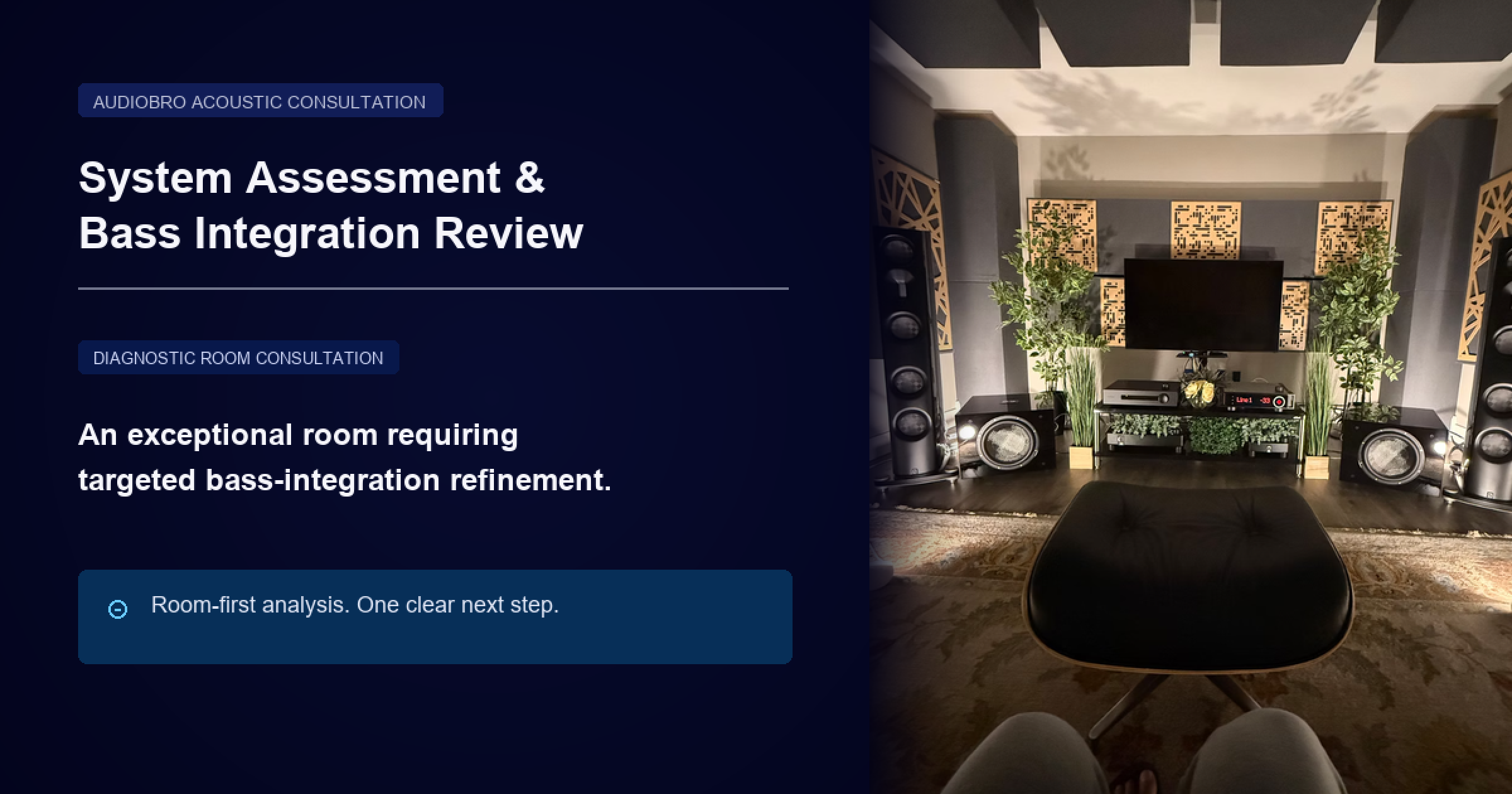
An experienced two-channel listener with a dedicated, professionally treated listening room had assembled Børresen C3 loudspeakers, two REL Carbon Special Black Label subwoofers, premium amplification and an available UMIK-1 measurement microphone. The room and system were already operating at a high level, but bass integration at the listening position remained inconsistent. Crossover adjustments changed the presentation without reliably resolving the remaining frustration.
The System and The Challenge
Context: An experienced two-channel listener with a dedicated, professionally treated listening room
System: Børresen C3 loudspeakers, two REL Carbon Special Black Label subwoofers, premium amplification and an available UMIK-1 measurement microphone
Symptoms: The room and system were already operating at a high level, but bass integration at the listening position remained inconsistent. Crossover adjustments changed the presentation without reliably resolving the remaining frustration.
Room Constraints
- Both subwoofers occupied individually strong front-wall positions
- The room already had extensive broadband absorption, corner treatment and a large ceiling cloud
- Loudspeaker placement, listening position and left-to-right symmetry were strong
- Additional equipment or more treatment was not justified by the available evidence
- The next experiment needed to preserve the excellent existing reference and change only one variable
The Starting Point
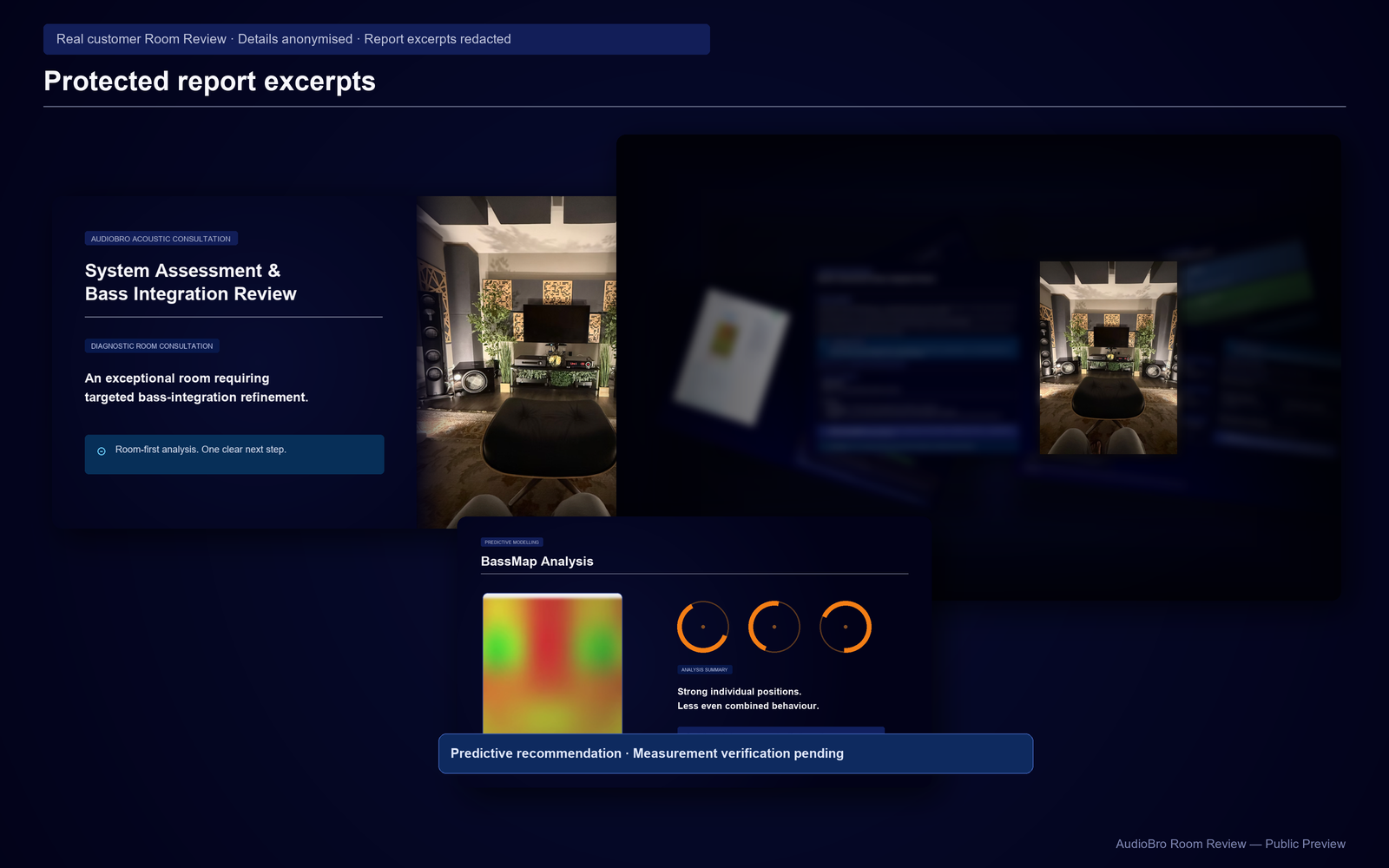
This was not a poor room needing wholesale correction. The supplied photographs showed strong symmetry, carefully considered loudspeaker placement, a listening position away from the rear wall and substantial treatment. Those observations established that the room foundations were strong, but photographs could not prove how the two subwoofers combined at the listening seat. The useful question was therefore narrow: was crossover adjustment the real issue, or were two individually capable bass sources interacting with the room as a pair?
Investigation & Modelling
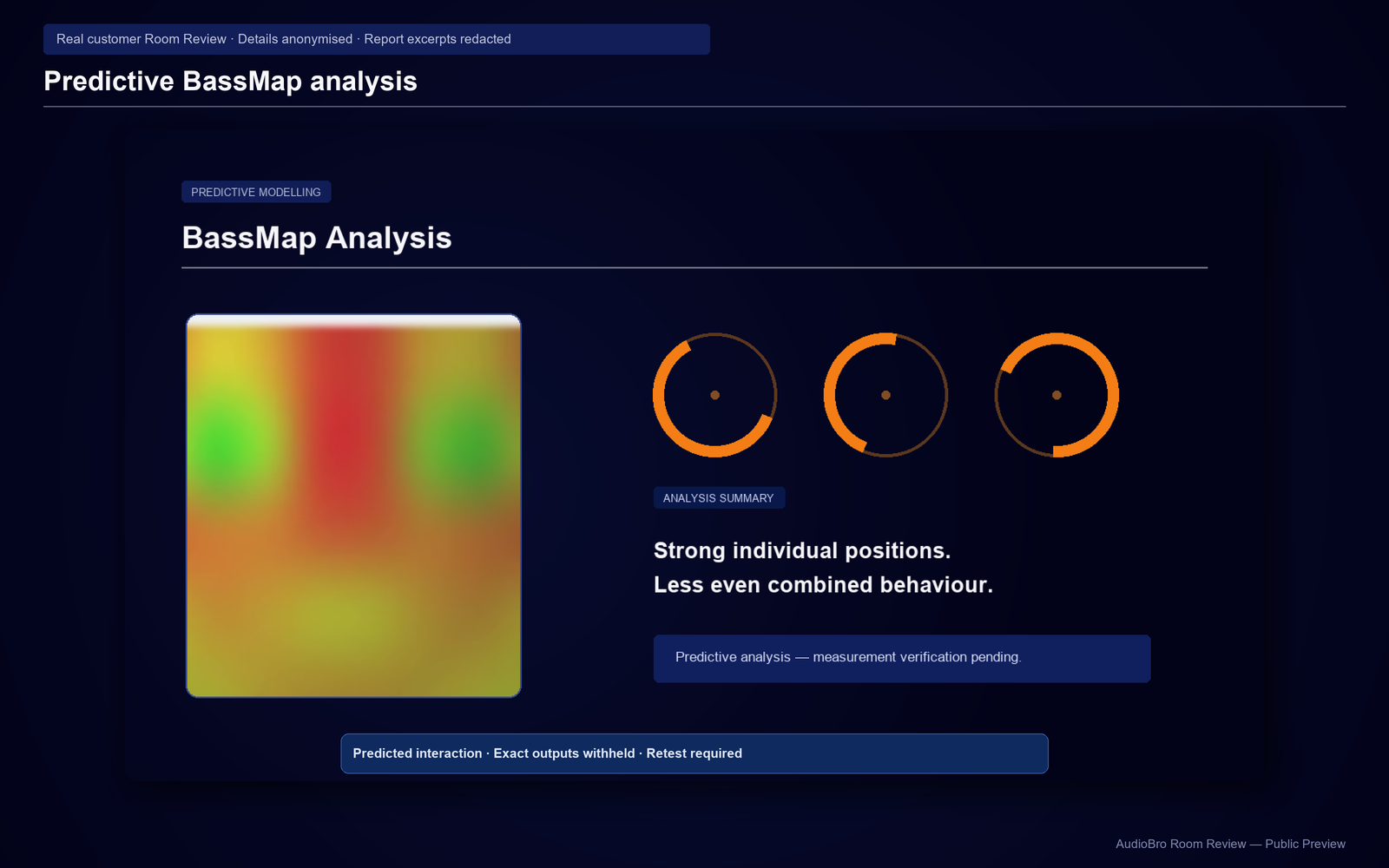
AudioBro kept visual observation, predictive modelling and measurement truth separate. Predictive BassMap analysis indicated that the two front-wall positions were individually strong while their combined behaviour was less even. That did not prove the existing layout was wrong. It identified dual-subwoofer interaction as the most defensible hypothesis to test. Because both sources occupied similar positions along the same boundary, controlled asymmetry could change how they excited the room. The review therefore avoided inventing a fault, changing multiple settings or treating prediction as measurement.
Predictive BassMap analysis—not measured. The model identified a placement hypothesis for a controlled trial, not a verified acoustic result.
Implemented Placement Change
AudioBro converted the hypothesis into one reversible experiment. The existing crossover arrangement, gain, phase, left-subwoofer position and listening seat remained the reference. Only the right subwoofer moved to the recommended trial zone so the original and trial layouts could be compared without confusing placement with another variable.
- Preserve the 65 Hz high-pass and 55 Hz low-pass crossover reference
- Leave the left REL in its existing front-left position
- Photograph and mark the original right-subwoofer position
- Move only the right REL to the recommended rear-left trial zone
- Keep gain, phase, listening seat, tracks and playback level unchanged
- Compare the original and trial layouts and retain the move only if the result remained repeatable
- Use the available UMIK-1 if the result was unclear or further refinement was wanted
After implementing AudioBro’s first recommended placement change, Charlie reported that the congestion was gone, bass response in the room had vastly improved and extended listening was now beyond his expectations. A US$97 Room Review had helped unlock substantially more performance from a six-figure room and system without another equipment purchase. He had zero complaints, wanted to explore what more was possible and asked which AudioBro subscription he should use to continue.
Placement trial completed and customer-confirmed by listening. Not measurement-verified.
Verification Pending
This is Charlie’s customer-reported listening outcome, used with his permission. It is not measurement-verified: no matched UMIK-1 before-and-after comparison was completed, so the size, frequency range and measured cause of the change remain unverified.
Why This Case Matters
Two capable subwoofers do not automatically behave as one coherent system at the listening position. AudioBro protected the strong existing reference and recommended one reversible placement trial before more equipment, treatment or premature EQ. Charlie then reported that the congestion was gone, bass response had vastly improved and one change made him wonder what more was possible. That is the AudioBro approach: find the most defensible first move, listen carefully, preserve what works and let the result determine what comes next.
Customer follow-up — one week later
Customer Outcome
After implementing AudioBro’s first recommended placement change, Charlie reported that the congestion was gone, bass response in the room had vastly improved and extended listening was now beyond his expectations. A US$97 Room Review had helped unlock substantially more performance from a six-figure room and system without another equipment purchase. He had zero complaints, wanted to explore what more was possible and asked which AudioBro subscription he should use to continue.
I was shocked. The congestion is gone, bass response in the room has vastly improved, and what I hear now is well beyond the expectations I had.
- Charlie implemented the first recommended change while the remaining setup variables stayed as the reference.
- He reported that the congestion was gone and bass response in the room had vastly improved.
- He was enjoying extended listening sessions and said the result was well beyond his expectations.
- He had zero complaints and wanted to explore what more was possible.
- Charlie asked which AudioBro subscription he should use to continue the process.
Planned continuation
What happens next
After asking which AudioBro subscription was appropriate, Charlie purchased Pro Lifetime. He will now get familiar with the platform and continue the same room investigation from the result already achieved.
- Measure the room, main loudspeakers and subwoofers to establish the next evidence baseline.
- Use Tune My Sub to examine whether the already satisfying bass can be refined further.
- Assess what additional performance may still be available from the highly capable main loudspeakers.
These are planned next steps, not completed outcomes. Any further improvement will be reported only after the relevant listening and measurement work has been completed.
This is Charlie’s customer-reported listening outcome, used with his permission. It is not measurement-verified: no matched UMIK-1 before-and-after comparison was completed, so the size, frequency range and measured cause of the change remain unverified.
Want AudioBro to review it for you?
If your system should sound better than it does and you want room-first guidance before spending more on equipment, AudioBro can review your room.