
5 Common Home Theater Mistakes (and How to Fix Them)
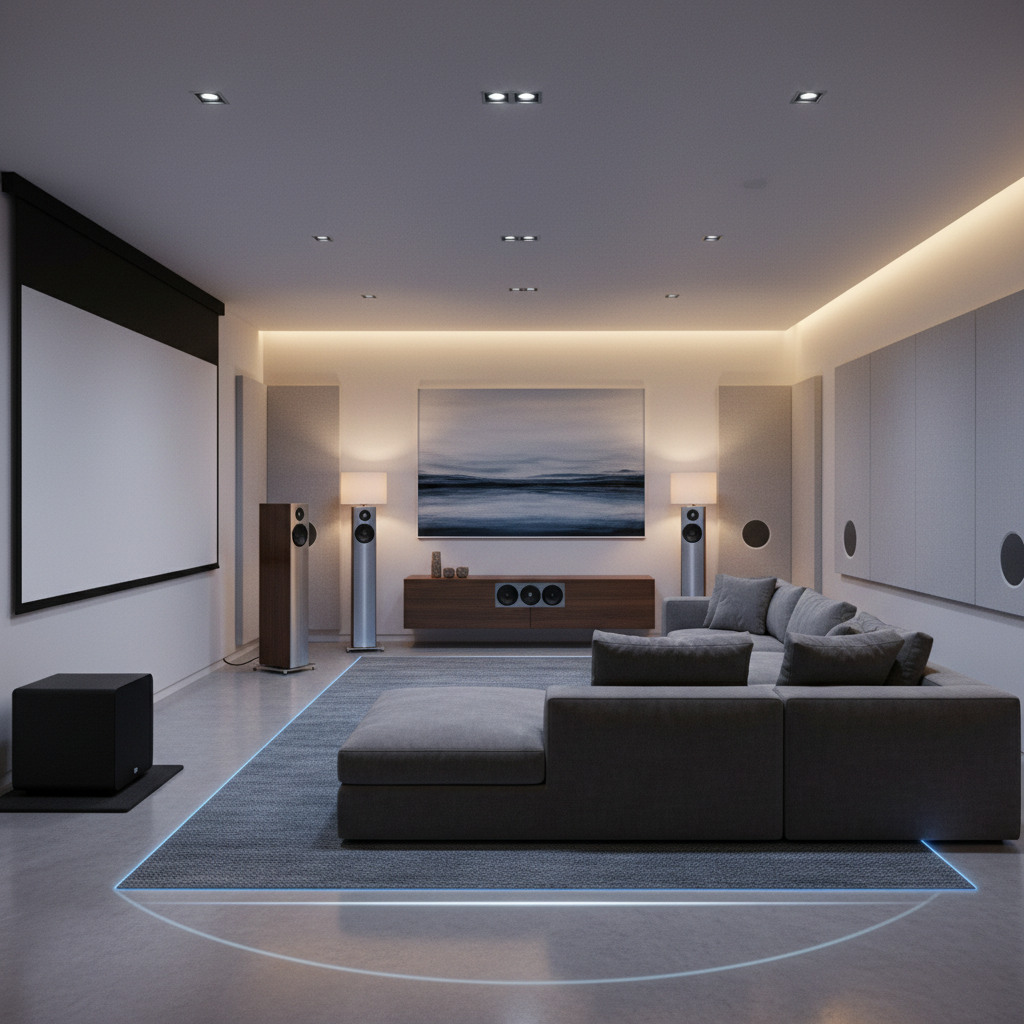
You've spent thousands on speakers, receivers, and that gorgeous 85" OLED display. But if you're making these common setup mistakes, you're leaving serious performance on the table. The good news? Most of these issues cost nothing to fix and can dramatically improve your experience in just a few minutes.
Mistake #1: The "Furniture Store" Speaker Placement
What You're Doing Wrong: Placing speakers wherever they look good or fit conveniently—usually shoved into corners, against walls, or buried in entertainment centers.
Why It Hurts: Speakers aren't decorative objects. Their placement affects everything from dialogue clarity to bass response. Corner placement creates boomy, one-note bass. Against-the-wall placement causes reflections that muddy the midrange — a problem known as Speaker Boundary Interference (SBIR). Entertainment center placement blocks high frequencies and creates a boxy, confined sound.
The Fix:
- Front speakers: Pull them at least 2-3 feet from the front wall, 1-2 feet from side walls
- Create the triangle: Distance between left/right speakers should equal distance from each speaker to your head
- Toe-in: Angle speakers so they point directly at your ears
- Height matters: Tweeters at ear level when seated
Real-world example: Simply moving bookshelf speakers from an entertainment center to dedicated stands can improve dialogue clarity by 20-30% and eliminate that "talking through a cardboard box" effect.
Mistake #2: Subwoofer in the Corner (The "Bass Boom")
What You're Doing Wrong: Placing your subwoofer in the nearest corner because "bass isn't directional" and it's convenient.
Why It Hurts: Corners are bass traps that create massive peaks at certain frequencies while completely canceling others. Result: One-note, boomy bass that overwhelms some scenes and disappears in others. Your $2,000 subwoofer sounds worse than a $200 one properly placed.
The Fix:
- Try the "subwoofer crawl": Place the sub where you normally sit, then crawl around the room listening for the smoothest bass
- Avoid corners and walls when possible
- The 1/3 rule: Try placing the sub 1/3 of the way along a wall length
- Two subs are better than one: If budget allows, two smaller subs in different positions create smoother bass than one large sub
Quick test: Play a bass sweep (available free online) and listen for which frequencies boom or disappear. Good bass should be smooth and even across all frequencies.
Mistake #3: Setting All Speakers to "Large"
What You're Doing Wrong: In your receiver settings, you've set all speakers to "Large" because bigger must be better, right?
Why It Hurts: Unless you own massive tower speakers, most bookshelf speakers can't handle deep bass effectively. Setting them to "Large" forces them to play frequencies they're not designed for, creating distortion and taking power away from the frequencies they excel at.
The Fix:
- Set most speakers to "Small": This redirects bass below 80Hz to your subwoofer
- 80Hz crossover: Start here for most bookshelf speakers; adjust if needed
- Only true full-range speakers (large towers with multiple woofers) should be set to "Large"
- Match your speakers' specs: Check the manufacturer's recommended crossover frequency
The result: Cleaner midrange from your main speakers, better bass from your subwoofer, and more headroom for loud scenes.
Mistake #4: Room Correction as a Magic Fix
What You're Doing Wrong: Relying entirely on Audyssey, YPAO, or other automatic room correction to fix everything while ignoring basic speaker placement and room acoustics.
Why It Hurts: Room correction is powerful, but it can't fix fundamental problems like speakers in terrible positions or rooms with excessive reflections. It's like using Photoshop to fix a blurry photo—there are limits to what software can accomplish.
The Fix:
- First: Get speaker placement right (see mistakes #1 and #2)
- Then: Add basic acoustic treatment if needed—even a thick rug and some furniture helps
- Finally: Run room correction as the cherry on top
- Don't over-correct: Most room correction works best with light touch-ups, not heavy EQ
Pro tip: Many room correction systems have different house curve options. Try them all and pick what sounds best to your ears—the "flattest" measurement doesn't always sound the most natural.
Mistake #5: Ignoring the Room Itself
What You're Doing Wrong: Focusing entirely on equipment while ignoring that your room is actually the largest component in your audio system.
Why It Hurts: Hard surfaces create reflections that blur stereo imaging. Parallel walls create standing waves that cause bass peaks and nulls. Glass, tile, and concrete turn your listening room into an echo chamber. No amount of expensive gear can overcome a terrible acoustic environment.
The Fix (Budget-Friendly Options):
- Add soft furnishings: Heavy curtains, thick rugs, upholstered furniture
- Break up parallel walls: Bookcases, wall art, anything that creates irregular surfaces
- First reflection points: Place acoustic panels or even thick blankets where sound bounces from speakers to your ears
- Don't over-deaden: You want to control reflections, not eliminate them entirely
Advanced fixes:
- Proper acoustic panels at first reflection points
- Bass traps in corners if you have persistent bass issues
- Diffusion panels to scatter sound evenly
The AudioBro Solution: Automated Mistake Detection
Wondering which of these mistakes you're making? If you have room measurements, REW Shows You The Problem. AudioBro Explains What To Do About It. is the most comprehensive guide to understanding what they mean. Or AudioBro's AI can analyze photos of your room or measurement data and instantly identify the issues holding back your system.
Simply upload a photo of your setup and get:
✅ Specific speaker placement recommendations with distances and angles
✅ Subwoofer positioning guidance based on your room layout
✅ Room correction optimization tips for your specific receiver
✅ Acoustic treatment suggestions that actually work
✅ Priority ranking so you know which fixes will have the biggest impact
What to Expect When You Fix These Mistakes
Week 1: After optimizing speaker placement, you'll notice clearer dialogue, better stereo imaging, and more controlled bass.
Week 2: With proper room correction settings, dynamic range improves and loud scenes won't sound harsh.
Month 1: Add basic acoustic treatment, and you'll hear details in familiar music you never noticed before.
The bottom line: These five mistakes are probably costing you 50-70% of your system's potential performance. The good news? Most fixes cost nothing but time, and the improvements are immediately audible.
Ready to Stop Making These Mistakes?
Don't let common setup errors waste your audio investment. Start your free AudioBro analysis and discover what your system is truly capable of.
Your equipment is probably better than you think—it just needs proper setup to shine.