
Toe-In Explained
Why the angle of your speakers changes image focus and tonal balance.
By the end of this lesson…
Understand speaker toe-in, how it interacts with off-axis response and room reflections, and how to test the right angle for your setup.
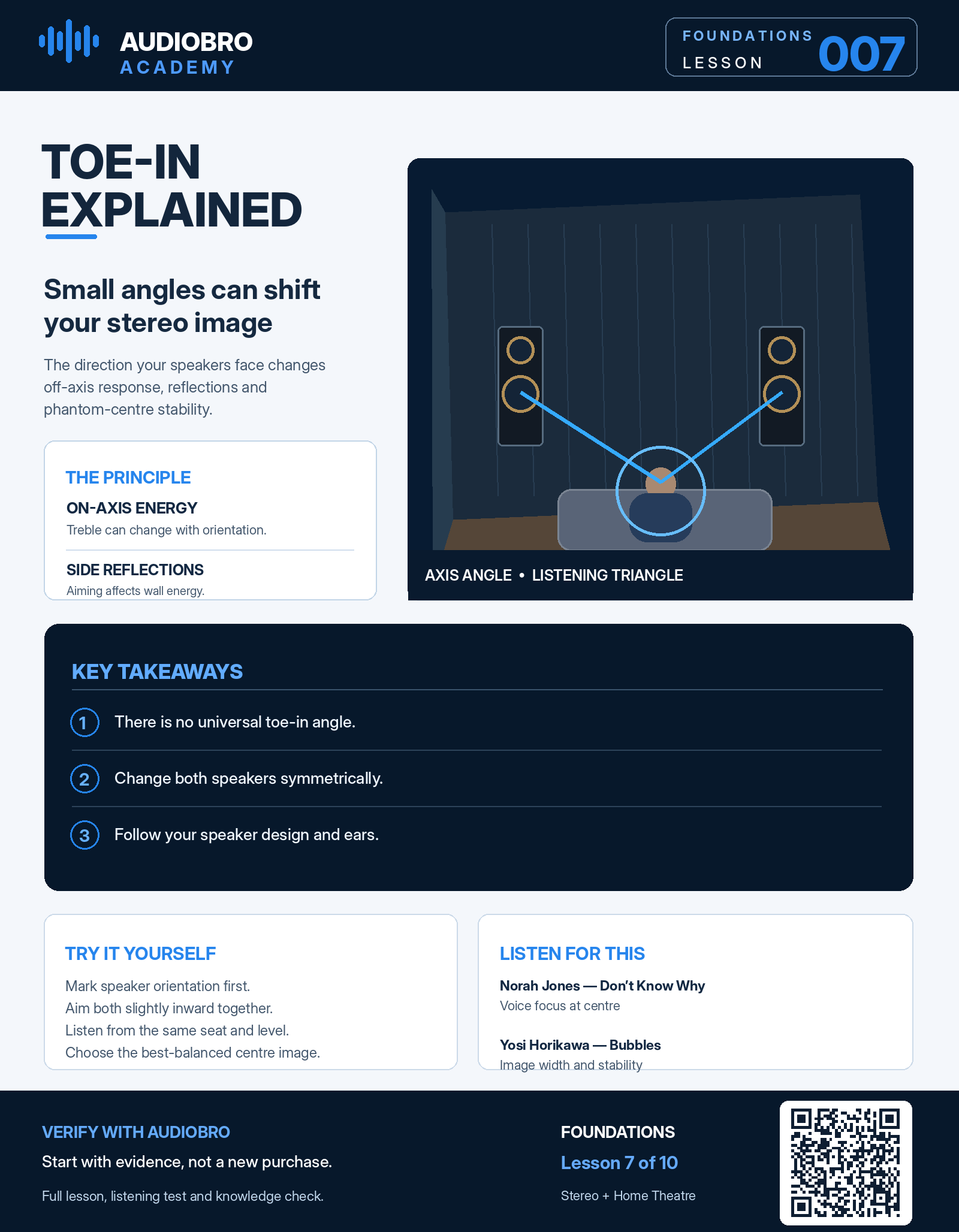
Sometimes a few degrees make a bigger difference than a new component.
Toe-in is the angle at which a speaker turns inwards towards the listener. It changes the angle between your ears and the speaker’s acoustic axis and can also change the sound reaching nearby side walls.
The right result depends on the speaker’s design, the room and the listening seats, not on a universal angle.
On-Axis and Off-Axis Sound
Speakers do not radiate the same frequency balance in every direction. Some maintain a fairly even response over a wide angle; others become quieter or change tonal balance more rapidly as you listen off-axis.
Changing toe-in changes which part of that directional behaviour reaches your ears. Depending on the speaker, this may affect treble balance, vocal focus and the perceived soundstage.
Toe-In Also Changes Reflections
Rotate a speaker and you change how strongly it illuminates different walls, although the exact effect depends on its radiation pattern and room layout.
A little more toe-in may reduce the energy reaching a side wall for some speakers, while also changing direct sound. It should never be advertised as a guaranteed cure for brightness or poor imaging.
Testing Toe-In Properly
Start by marking the current position and angle of both speakers. Face them straight ahead, or choose a repeatable baseline consistent with the manufacturer’s recommendation.
Now rotate both inward in small, symmetrical steps without changing their locations. Listen from the same seat at the same volume.
A stable central vocal is a useful clue. Also listen for a soundstage that is appropriately wide and well balanced, not just artificially sharp. Some designs work best aimed directly at the listener; others deliberately favour an off-axis response.
For off-centre seats, consider how the result changes for other listeners. An angle that locks one sweet spot into focus might not offer the best compromise for the room.
The Big Idea
Toe-in is a reversible way to tune directional balance and stereo imaging, but the speaker’s actual off-axis behaviour sets the rules.
Key Takeaways
- Toe-in changes the listener’s angle to the speaker’s acoustic axis.
- Off-axis behaviour varies between speaker designs.
- The effect can include tonal balance, reflection level and stereo imaging.
- Adjust both speakers in controlled, symmetrical steps.
- There is no universal best toe-in angle.
Try It Yourself
The two-angle comparison
- Mark each speaker’s current footprint and aiming direction.
- Listen to a centred vocal and a track with clear spatial detail.
- Rotate both speakers inward by a small equal angle without moving them.
- Compare vocal focus, high-frequency balance and stage width.
- Restore the starting angle before choosing your preference.
Do not force heavy speakers to rotate on spikes or unstable stands; protect the floor and cables.
Listen For This
Norah Jones — Don't Know Why
Listen for a stable central voice and natural presence.
Yosi Horikawa — Bubbles
Listen for lateral image stability, depth and believable width.
Common Misconception
“Both speakers should always point directly at the listener’s nose.”
Not necessarily. Some speakers are designed or voiced to sound best a little off-axis. The right angle depends on the radiation pattern and your preferred balance.
Verify With AudioBro
RoomMatch can help visualise the basic speaker-to-listener aiming geometry. To understand whether the tonal changes are caused by the speaker’s radiation pattern, consult manufacturer measurements and compare carefully controlled listening tests.
Want the Full Methodology?
Get the complete step-by-step diagnostic protocol.
Explore the Room Diagnostic ProtocolKnowledge Check
What is toe-in mainly changing?
Get the next Academy lesson.
Join the free AudioBro Academy email list for new lessons and occasional practical guides to better sound. Education first, always.
Aim with a purpose. Listen for balance, not just sharpness.