
What Is SBIR?
Why nearby walls can cancel bass, even when your speakers are working properly.
By the end of this lesson…
You'll understand why nearby walls can create deep dips in your speaker response, why those dips often survive EQ, and why speaker placement can matter more than buying different equipment.
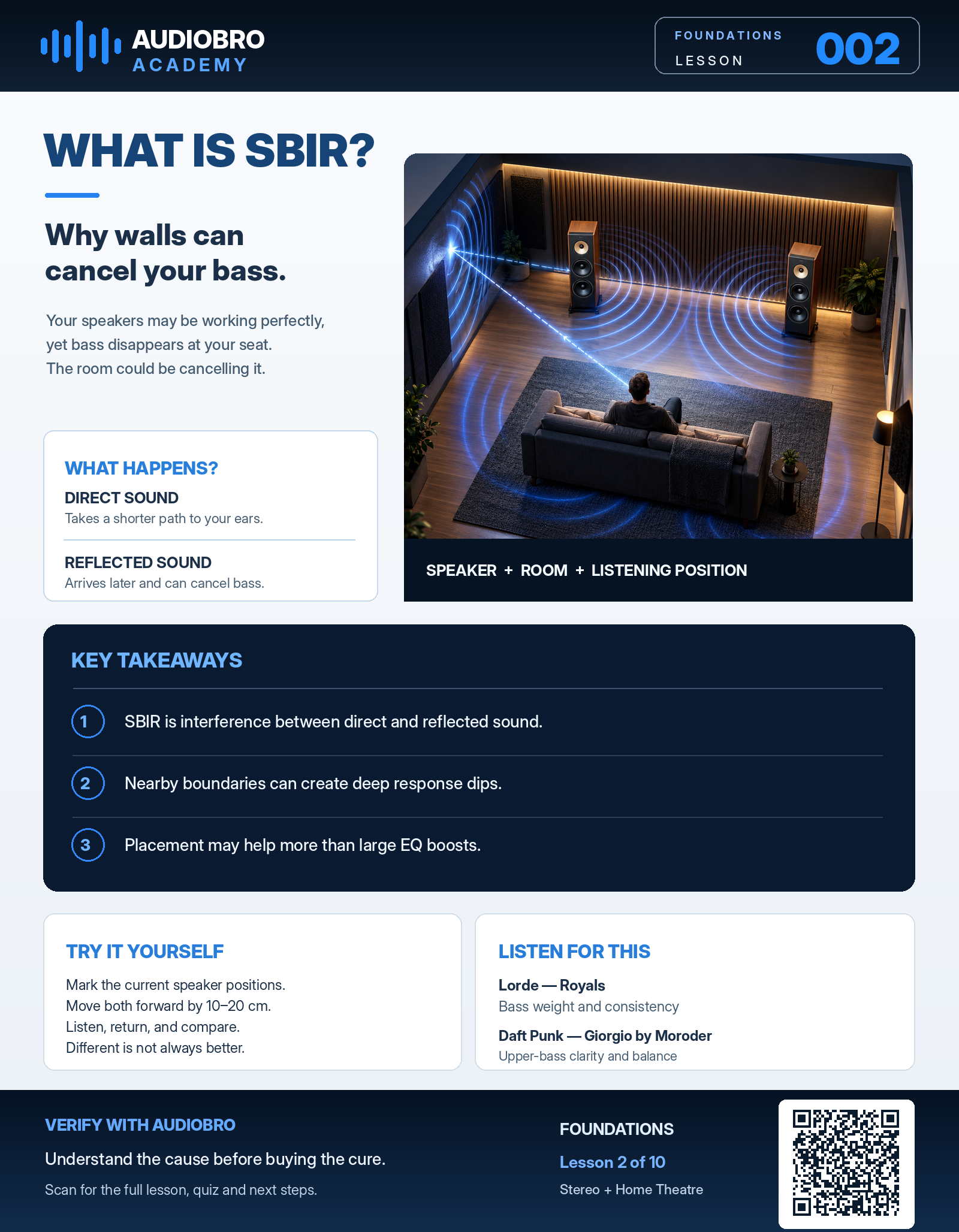
Your speaker can produce the frequency perfectly... and you still might not hear it properly.
Imagine your speaker plays a bass note.
Part of that sound travels directly towards you. Another part travels backwards or sideways, hits a nearby wall, then reflects towards you.
Those two versions of the same sound arrive at slightly different times. At some frequencies they reinforce one another. At others they partially cancel.
That interaction is called Speaker Boundary Interference Response, or simply SBIR.
SBIR is one reason a good speaker can measure beautifully in a lab yet produce a deep dip in your actual room.
Why It Happens
Direct sound meets reflected sound
Every speaker produces sound into the room. The listener receives direct sound from the speaker and reflected sound from nearby boundaries.
The reflected sound travels further. That extra distance creates a delay.
When the reflected wave arrives sufficiently out of phase with the direct wave, the two partially cancel.
The result can be a deep reduction at a particular frequency. On a frequency-response graph, this often appears as a broad or deep dip.
The Boundary Matters
SBIR can involve reflections from:
- The wall behind the speakers
- Side walls
- Floor
- Ceiling
- Other large nearby boundaries
In many stereo systems, the front wall behind the speakers is particularly important because speaker-to-wall distance strongly influences the frequency at which a major cancellation occurs.
Move the speaker. You change the path length.
Change the path length. You change the cancellation frequency.
That is why relatively small placement changes can create surprisingly large differences.
The Simple Mental Model
Think of SBIR like two people pushing a swing. If both push at the same moment, the motion becomes stronger. If one pushes while the other pushes against it, some of the motion disappears.
Sound waves can behave similarly. Direct sound and reflected sound can add together or work against one another depending on their timing.
Why EQ Often Does Not Solve It
A common reaction to a response dip is:
“I'll just boost that frequency with EQ.”
But SBIR is often a geometry problem. If direct and reflected sound are cancelling each other acoustically, adding more electrical level may simply send more energy into the same cancellation.
This is why severe SBIR dips are often better addressed through speaker placement, listening position, boundary distance or acoustic treatment where appropriate before relying on large EQ boosts.
EQ can sometimes help. The lesson is to investigate geometry before trying to force a deep cancellation flat electronically.
SBIR vs Room Modes
These are often confused.
SBIR: Primarily caused by interaction between direct sound and a reflection from a nearby boundary.
Room modes: Created by standing-wave behaviour related to the dimensions of the room.
Both can create peaks and dips. But they are not the same problem. Because the causes differ, the solutions may differ too.
A graph tells you that a dip exists. It does not automatically tell you why.
The Big Idea
A frequency-response dip does not automatically mean your speaker is weak at that frequency.
Sometimes the speaker is producing plenty of energy. The room is simply cancelling part of it before it reaches you.
That is why changing equipment without understanding the cause can waste money.
Want the deeper explanation?
Read the complete SBIR guide for more detail and examples.
Key Takeaways
- SBIR means Speaker Boundary Interference Response.
- It occurs when direct and boundary-reflected sound interact.
- The interaction can create peaks and deep cancellations.
- Speaker-to-boundary distance changes where those cancellations occur.
- SBIR is often a placement and geometry problem before it is an EQ problem.
- SBIR and room modes are different phenomena, even though both can affect bass response.
Try It Yourself
Hear the effect of placement
Choose a familiar track with steady bass. Mark your current speaker position so you can return to it.
If your room and setup safely allow it:
- Move both front speakers approximately 10–20 cm forward.
- Replay the same section.
- Listen to bass weight and upper-bass clarity.
- Return the speakers to their original positions.
- Compare again.
You may hear little change. You may hear a surprising change.
The point is not that one direction is automatically better. The point is that changing boundary distance changes how the speaker and room interact.
Important: This experiment is not proof that every audible change is SBIR. It demonstrates that placement and boundaries can materially change the response.
Listen For This
Lorde — Royals
Listen for:
- Weight of the low-frequency pulse
- Whether some bass notes feel weaker than others
- Changes in solidity after moving the speakers
- Whether the vocal feels fuller or thinner
Daft Punk — Giorgio by Moroder
Listen for:
- Upper-bass consistency
- Bass-line definition
- Transition from bass into lower midrange
- Whether the presentation becomes fuller or hollow around certain notes
These tracks are listening exercises, not diagnostic instruments.
Common Misconception
“A deep dip means I need a better speaker.”
Not necessarily.
A different speaker placed in the same acoustic relationship with a boundary may encounter a similar problem.
Before replacing equipment, investigate distance from front and side walls, listening position, whether the dip appears in one or both channels, and whether the response changes when the speakers move.
The goal is to diagnose the cause before buying the cure.
Verify With AudioBro
The Academy explains why SBIR happens. AudioBro can help examine how your own speakers, boundaries and listening position interact.
Room photos and layout analysis can flag placement risks. Suitable measurements are needed to confirm the frequency and depth of a particular cancellation.
Want the Full Methodology?
Get the complete step-by-step diagnostic protocol.
Explore the Room Diagnostic ProtocolKnowledge Check
What is the most accurate description of SBIR?
Want Lesson 003 when it drops?
Join the free AudioBro Academy email list for new lessons and occasional practical guides to better sound. Education first, always.
Most systems aren't bad. They're simply limited by the rooms they're in.
Knowledge is the upgrade. Better decisions. Better sound.