
What's Really Happening In Your Room?
Learn how direct sound, reflections, room modes and boundary effects shape what you hear—and why room and speaker placement often matter more than equipment upgrades.
By the end of this lesson…
You'll understand why your room can influence what you hear more than many equipment upgrades—and why improving placement often delivers more value than replacing gear.
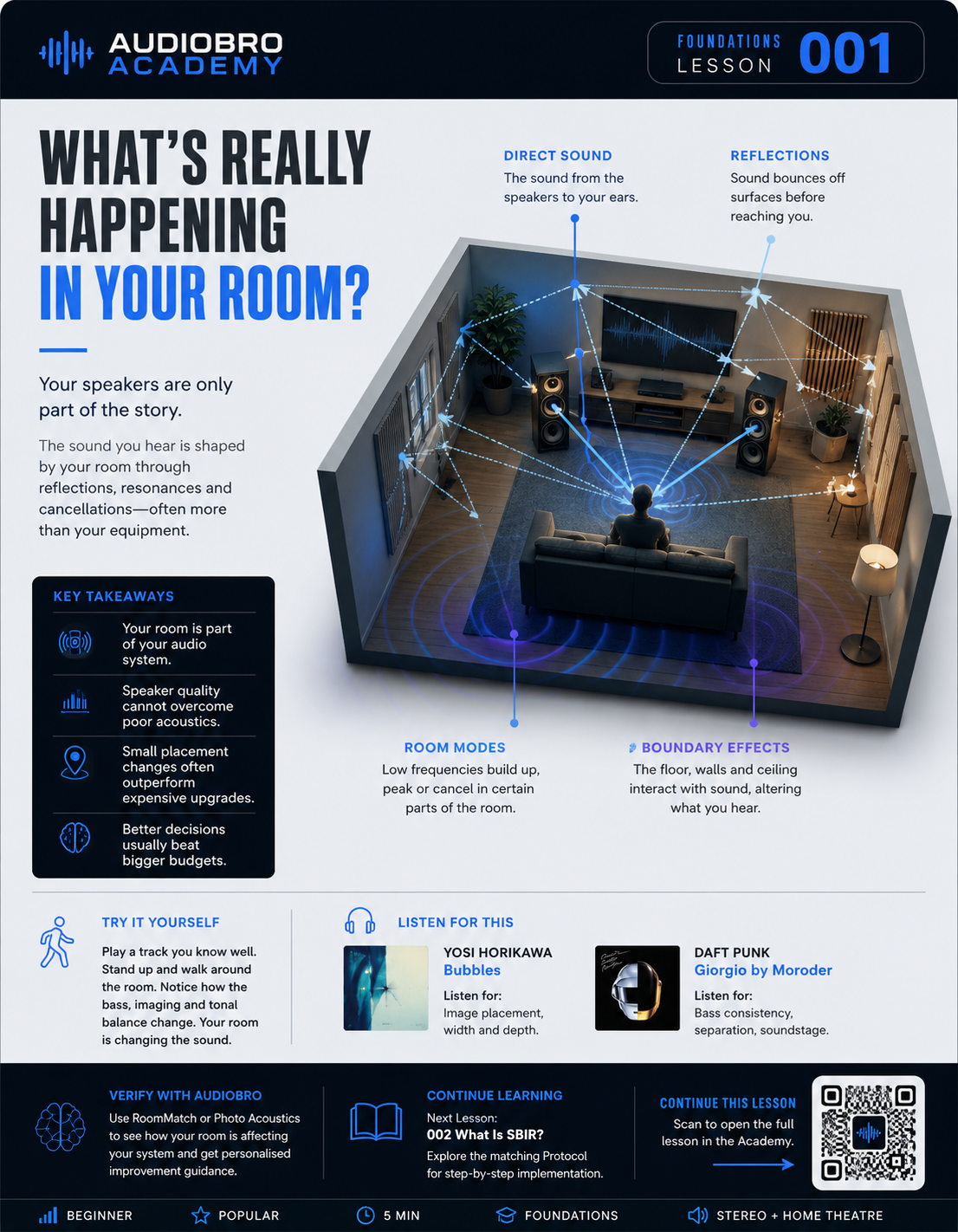
Most people blame their equipment.
Weak bass.
Boomy bass.
Poor dialogue.
Harsh treble.
Unfocused imaging.
When something sounds wrong, the natural reaction is to blame the speakers, amplifier, source or cables.
But in many systems, the equipment is not the main problem.
The room is.
Once sound leaves your speakers, it interacts with the walls, floor, ceiling, furniture, windows and listening position before it reaches your ears.
That means you are never hearing only your speakers.
You are hearing your speakers and the room around them.
This is why two identical systems can sound completely different in two different homes.
The Four Things You're Actually Hearing
1. Direct Sound
Direct sound travels from the speakers to your ears without first reflecting from another surface.
This is the clearest and most immediate part of what you hear.
It carries much of the timing, detail and spatial information that helps your brain locate voices and instruments.
2. Reflected Sound
Not all sound travels directly to you.
Some of it strikes the side walls, front wall, rear wall, floor, ceiling, windows and furniture before arriving at the listening position.
These reflections reach your ears slightly later than the direct sound.
When they are strong or arrive too early, they can blur imaging, reduce clarity and make the soundstage feel less focused.
Reflections are not automatically bad. Every normal room contains them.
The goal is to understand which reflections are helping the room feel natural and which ones are masking detail.
3. Room Modes
At low frequencies, sound behaves differently.
Bass wavelengths are long enough to interact strongly with the room's dimensions.
At certain frequencies, sound energy builds up. At others, it cancels.
These patterns are called room modes.
Room modes explain why bass can sound powerful in one seat, weak in another and uneven across the room—even though the subwoofer and volume setting have not changed.
4. Boundary Effects
Speakers and subwoofers interact with nearby walls, floors and ceilings.
The reflected sound from those boundaries combines with the direct sound.
Depending on the distance and frequency, the interaction can reinforce the sound or partially cancel it.
This is one reason moving a speaker or listening position by a relatively small amount can produce a surprisingly large change.
Your speakers create the sound. Your room shapes it.
Your equipment determines what the system is capable of producing.
Your room determines how much of that performance reaches you clearly.
Until you understand what the room is doing, it can be difficult to know whether a problem is caused by the equipment, the placement or the listening environment.
That is why AudioBro starts with the room before recommending more gear.
Key Takeaways
- Your room is part of your audio system.
- Every room changes sound differently.
- Direct sound, reflections, room modes and boundary interactions arrive together at your ears.
- Speaker and listening-position changes can produce major improvements.
- Better decisions often deliver more value than bigger budgets.
Try It Yourself
Play a track you know well and sit in your normal listening position.
Listen carefully to the bass, vocals and location of instruments.
Now stand up and slowly move around the room.
Try moving:
- Forward and backward
- Left and right
- Closer to a wall
- Away from a wall
Notice what changes.
- Does the bass become stronger in some places?
- Does it almost disappear in others?
- Do vocals become clearer or less focused?
- Does the centre image move?
Nothing about the equipment changed.
Only your position changed.
That is the room altering what you hear.
Listen For This
Yosi Horikawa — Bubbles
Listen for:
- Precise placement of individual sounds
- Width beyond the speakers
- Front-to-back depth
- Whether each sound occupies a stable position
- Whether reflections make the image feel sharp or blurred
Daft Punk — Giorgio by Moroder
Listen for:
- Bass consistency
- Instrument separation
- Centre-image stability
- Soundstage width
- Whether the presentation becomes congested as the arrangement grows
Common Misconception
"I need better speakers."
Sometimes better speakers are the right answer.
But replacing speakers before understanding the room can mean spending more money without solving the real problem.
Many systems improve significantly through changes to:
- Speaker placement
- Listening position
- Subwoofer placement
- Toe-in
- Reflection control
- Bass management
- Calibration
The smart sequence is:
Understand the room first. Upgrade the equipment second.
Explore This With AudioBro
This lesson explains the general principles.
AudioBro helps identify what is likely happening in your own room.
Use Photo Acoustics or RoomMatch to examine:
- Speaker placement
- Listening-position geometry
- Boundary proximity
- Visible reflective surfaces
- Room asymmetry
- Likely placement risks
AudioBro then turns those observations into clear next actions.
Want the Full Methodology?
Get the complete step-by-step diagnostic protocol.
Explore the Room Diagnostic ProtocolKnowledge Check
Why can the same pair of speakers sound different in two different rooms?
Get the next Academy lesson.
Join the free AudioBro Academy email list for new lessons and occasional practical guides to better sound. Education first, always.
Most systems aren't bad. They're simply limited by the rooms they're in.
Understanding the room is the first step towards unlocking the performance you already own.
Knowledge is the upgrade. Better decisions. Better sound.