
Speaker Placement
Why small changes in speaker position can transform imaging and bass balance.
By the end of this lesson…
Understand how speaker spacing, boundary distance, symmetry and toe-in affect the sound at your listening position.
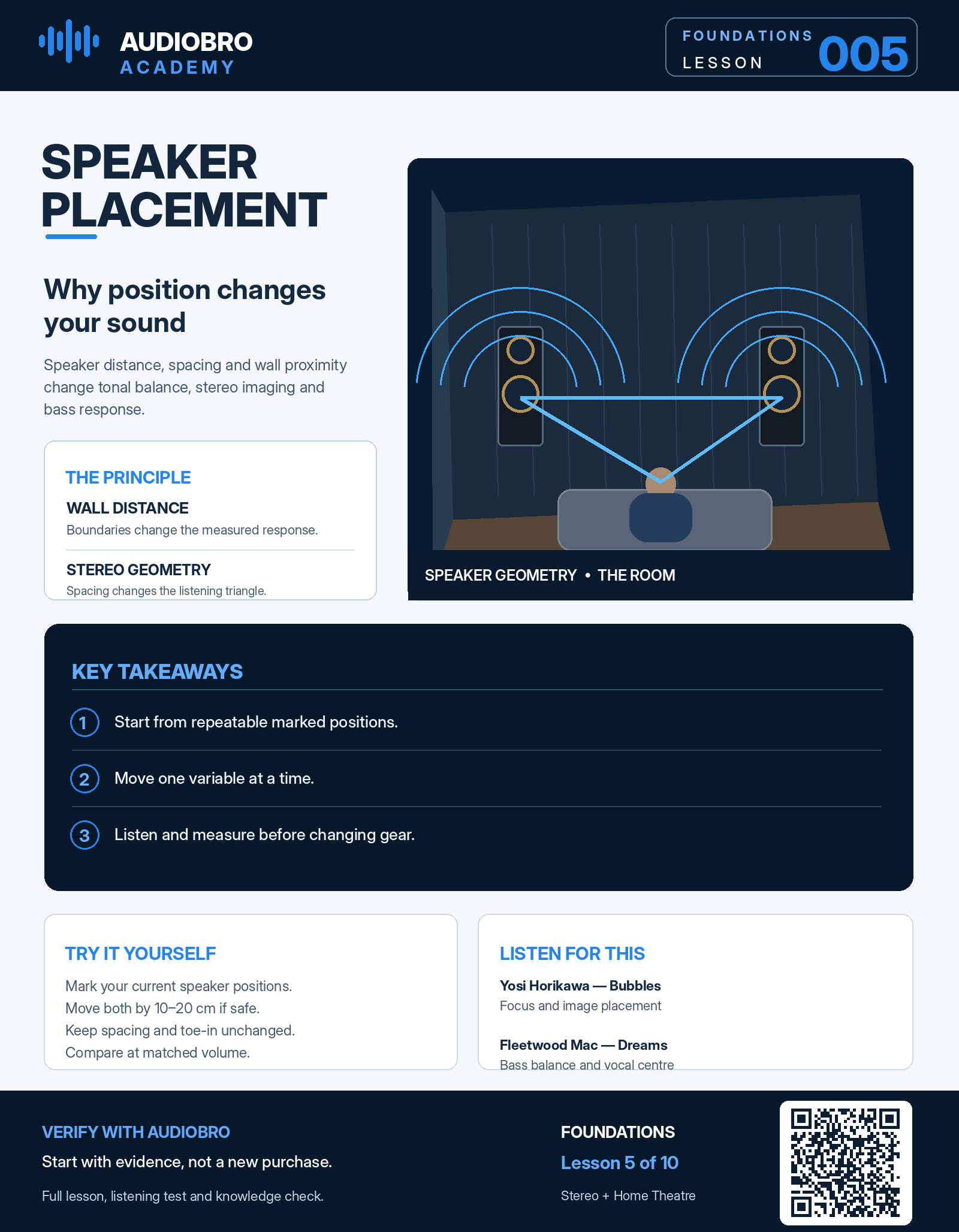
Before buying new speakers, try moving the ones you own.
Where a speaker sits relative to the listener and nearby boundaries changes the mix of direct and reflected sound. It also affects stereo geometry. This is why a speaker can sound open and focused in one position yet uneven or vague in another.
The goal is not to find one universal distance from the wall. It is to find a repeatable position that works in your room.
Three Distances Matter
Distance to walls: changes boundary reinforcement and the frequencies affected by speaker-boundary interference. Rear-ported speakers are not automatically required to sit far from a wall; follow the manufacturer’s guidance and test the actual room response.
Distance between speakers: changes the stereo stage and the geometry of the phantom centre. Too wide for the listening distance can leave a weak centre; too narrow may limit apparent width.
Distance to the listener: changes the balance of direct and reflected sound and affects how the stereo image forms.
Start With a Listening Triangle
For conventional stereo, an approximately equal-sided triangle is a starting point, not a law. Aim the speakers so the listener is in a suitable region of each speaker’s intended coverage.
Then account for real constraints: furniture, doors, screen location, walkways and multiple seats. A perfectly symmetric diagram may not fit an asymmetric room.
Change One Thing at a Time
If you move speakers forward and change their spacing and alter toe-in, it becomes difficult to know what caused a difference.
Mark a baseline. Move both speakers forward by a small, safe distance while preserving spacing and angle. Listen at the same level. Move them back. Keep simple notes.
Small shifts may produce audible changes because boundary path differences change. Not every change will improve the result, and not every bass change proves SBIR.
When Measurements Help
A measurement microphone can show how the response at the listening seat changes after a move. Left and right measurements separately can reveal differences hidden by combined playback.
Use the same mic position, level and sweep settings for reliable comparisons. A response plot can guide a decision, but imaging and personal priorities still deserve listening checks.
The Big Idea
Speaker placement is a tuning control you already own. Use it before assuming a new component is the answer.
Key Takeaways
- Wall proximity affects boundary interactions and bass balance.
- Speaker spacing and listening distance influence the stereo image.
- An equilateral triangle is a useful starting point, not a universal optimum.
- Mark positions and change one variable at a time.
- Use listening and repeatable measurements to confirm improvements.
Try It Yourself
The 10–20 cm placement experiment
- Mark the current location of both speakers and the direction each faces.
- If safe, move both forward by 10–20 cm, keeping spacing and toe-in unchanged.
- Replay one familiar passage at matched volume.
- Note bass balance, vocal focus and image width.
- Return to the original marks and compare before deciding.
Protect cables and avoid moving large, unstable or spiked speakers without help.
Listen For This
Yosi Horikawa — Bubbles
Listen for precise placement and a stable phantom image.
Fleetwood Mac — Dreams
Listen to the interaction between bass, kick drum and central vocal.
Common Misconception
“Pulling a speaker 10 cm forward is always better.”
There is no magic direction or distance. A move changes the geometry and may improve, worsen or barely affect the sound. The experiment is about finding evidence for your room.
Verify With AudioBro
RoomMatch can help evaluate speaker and listening geometry, clearances and likely boundary risks. Photo Acoustics provides additional information on visible room surfaces. Measurements are preferable when deciding whether a particular dip or peak has improved.
Want the Full Methodology?
Get the complete step-by-step diagnostic protocol.
Explore the Room Diagnostic ProtocolKnowledge Check
Why is it best to change one speaker-placement variable at a time?
Get the next Academy lesson.
Join the free AudioBro Academy email list for new lessons and occasional practical guides to better sound. Education first, always.
Measure a change. Hear a change. Keep it only if it helps.