
First Reflection Points
How early reflections affect clarity, stereo imaging and the space around your music.
By the end of this lesson…
Recognise the difference between direct and early reflected sound, locate likely first-reflection paths and decide when treatment is worth considering.
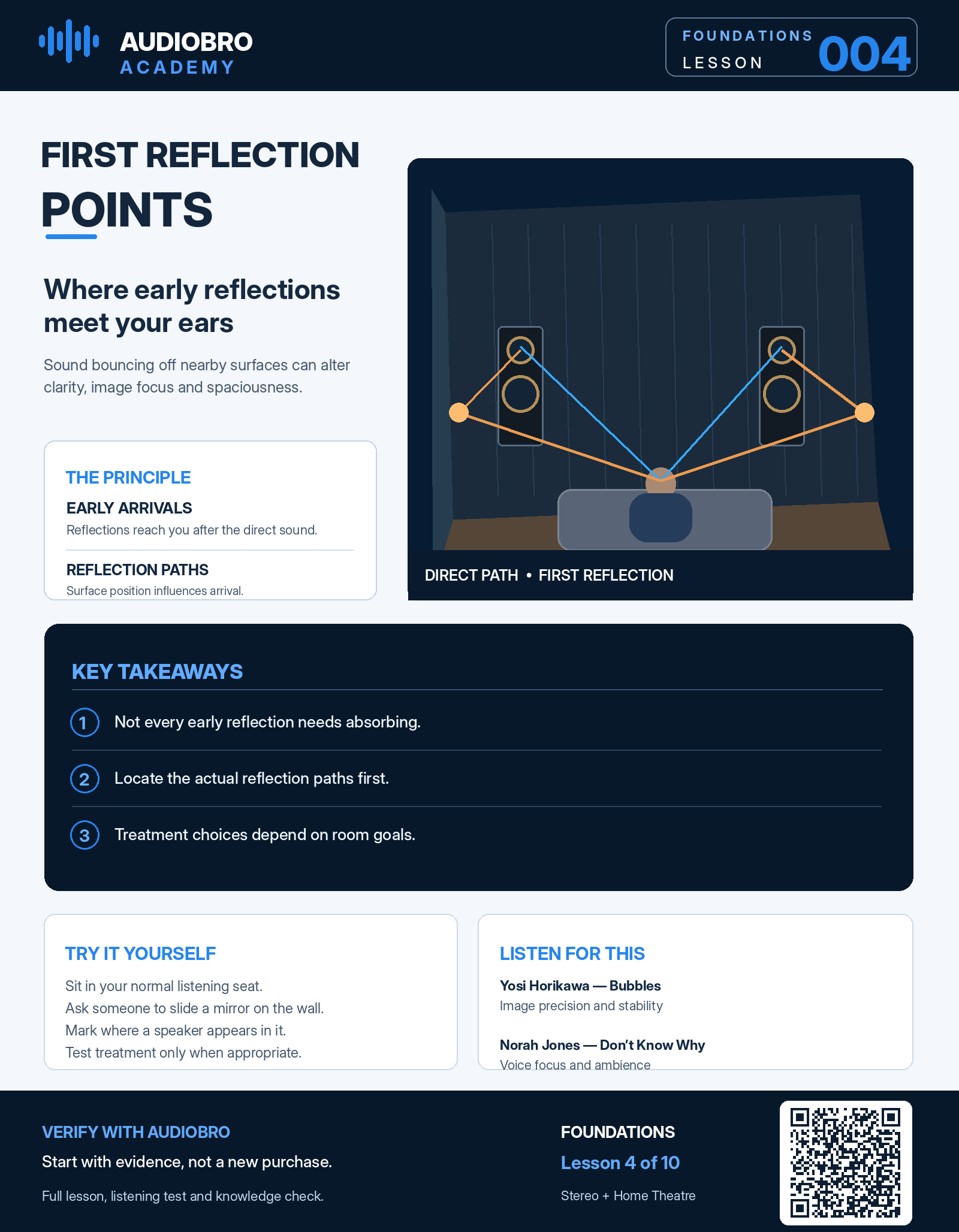
Some sound reaches your ears by taking the scenic route.
The direct sound arrives from a speaker first. Other sound strikes a side wall, floor or ceiling before reaching you. Those later arrivals are reflections.
The first significant reflection from a surface may affect tonal balance and image clarity, but reflections also contribute to the sense of space. Understanding their timing and direction matters more than simply covering walls with panels.
What Is a First Reflection Point?
Imagine a line from the speaker to a nearby wall and then to your ear. The place where the sound bounces is one possible first-reflection point.
On a smooth, approximately flat surface, the law of reflection gives a useful geometric model: the angle of incidence equals the angle of reflection. This model is especially useful at frequencies where the surface is large relative to the wavelength.
Real rooms are more complicated. Furniture, surface texture and speaker directivity affect reflected energy, and very low frequencies do not behave like neat rays.
Why the First Arrivals Matter
A strong reflection arriving shortly after direct sound can change the frequency response at the seat. Depending on its delay, spectrum and direction, it may also influence stereo image width, apparent spaciousness and precision.
That does not make every early reflection harmful. Some lateral energy can create a pleasant sense of width. The appropriate balance depends on the speaker, room, listening distance and whether the goal is music listening or precise monitoring.
Where Should You Look?
For conventional stereo speakers, side walls, the ceiling and the floor are common reflection paths. A desk or coffee table can also matter. A TV, windows and asymmetric furnishings may create very different responses for left and right speakers.
A widely used practical starting point is the mirror test. While seated at the main listening position, ask someone to move a mirror along a side wall. Where you can see the loudspeaker in the mirror is a likely specular reflection point for that speaker.
The test identifies a geometric candidate, not proof of an audible problem or a recommendation to absorb it.
Absorb, Diffuse or Leave It Alone?
Absorption reduces reflected energy in a frequency-dependent way. Thin panels are usually more effective in the mid and high frequencies than in deep bass.
Diffusion redistributes some reflected energy and requires appropriate design, distance and frequency range.
Leaving a reflection alone may be sensible when the room already sounds balanced or the reflection contributes positively to spaciousness.
Start with listening, placement and evidence. Treatment should solve a defined problem, not fill an empty patch of wall.
The Big Idea
Reflection control is a decision about energy, timing and the listening goal, not a blanket instruction to cover every reflective surface.
Key Takeaways
- Direct sound reaches you without first striking a surface.
- Early reflections can affect imaging, frequency balance and spaciousness.
- The mirror test locates likely geometric reflection paths, not proven problems.
- Absorption and diffusion work over different frequency ranges.
- Treat only after deciding what you want to improve.
Try It Yourself
Find a likely side-wall reflection point
- Sit in your normal listening position at ear height.
- Ask another person to move a small mirror slowly along a side wall.
- Mark the area where you first see the left or right speaker in the mirror.
- Repeat for the opposite wall. Compare how symmetric the positions are.
- Listen before and after placing a temporary, safe absorptive object near the point, if practical.
Do not use the mirror test as a low-frequency model, and do not assume a change is automatically an improvement.
Listen For This
Yosi Horikawa — Bubbles
Listen for the sharpness and stability of apparent sound positions.
Norah Jones — Don't Know Why
Listen for a stable central vocal and natural sense of room ambience.
Common Misconception
“Every first reflection must be absorbed.”
No. The goal is a balanced listening experience, not the absence of reflections. Speaker directivity, room size, symmetry and the desired presentation all influence whether, and how, to treat a reflection.
Verify With AudioBro
Photo Acoustics can flag visible reflective surfaces and layout asymmetry. RoomMatch can help reason about the speaker-to-seat geometry. A photo cannot establish precise arrival times or prove the best panel type or thickness; measurements or controlled listening may still be required.
Want the Full Methodology?
Get the complete step-by-step diagnostic protocol.
Explore the Room Diagnostic ProtocolKnowledge Check
What does the mirror test primarily identify?
Get the next Academy lesson.
Join the free AudioBro Academy email list for new lessons and occasional practical guides to better sound. Education first, always.
Treat the reflection that causes a problem, not every surface that reflects.