
Great Sound Is a System
Bring speakers, room acoustics, listening position and measurements together.
By the end of this lesson…
Understand how the Foundations lessons connect, and create one practical, measurable improvement plan for your own setup.
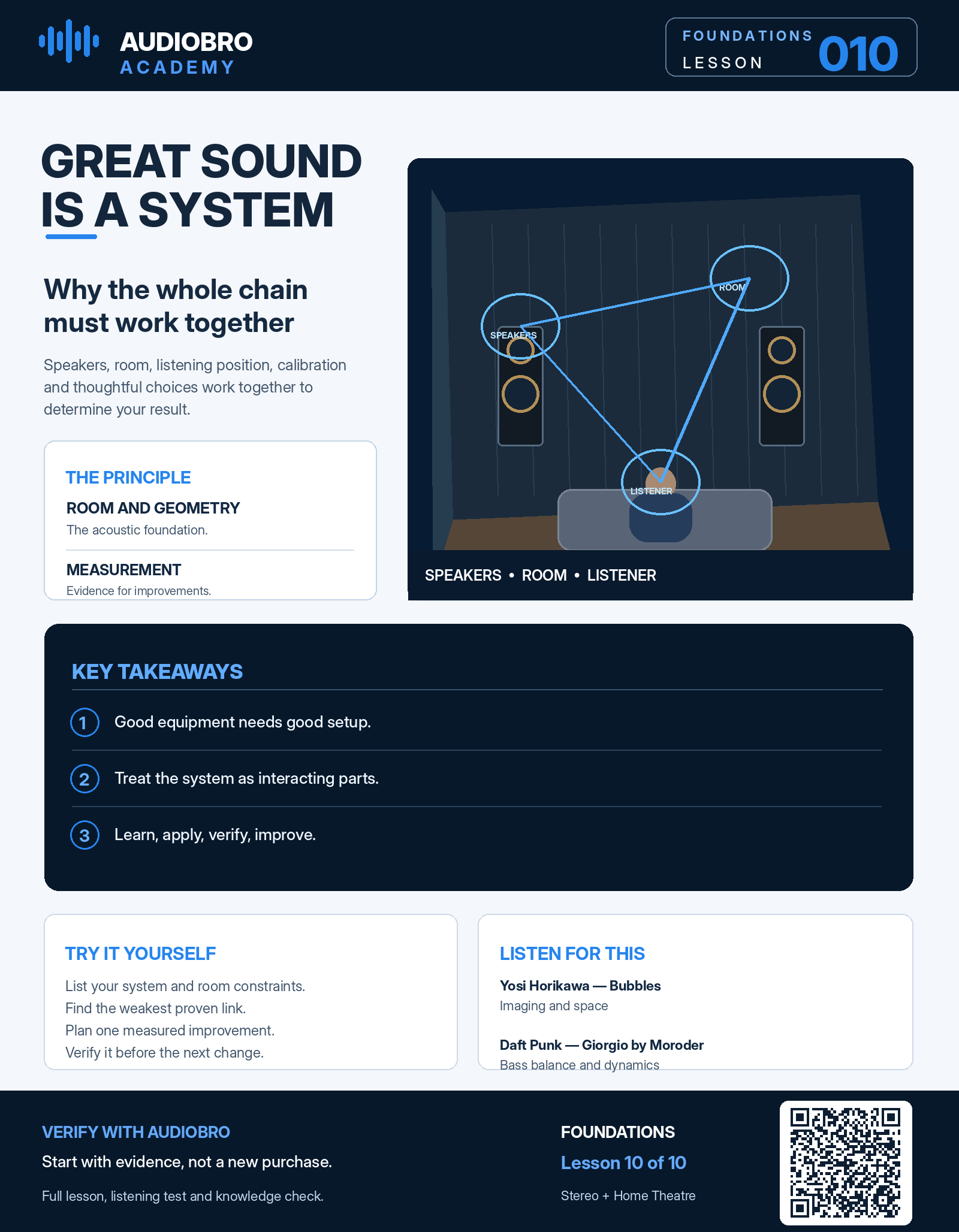
Great sound is not a single product.
Your loudspeakers create sound. The room modifies it. The listening position decides which part of that acoustic field reaches you. Configuration, amplification and processing influence what the speakers are asked to produce.
A good result comes from these elements working together, not from assuming any one component can compensate for every weakness elsewhere.
The Foundations Connected
Lesson 001 — Your Room: establishes that walls, furniture, dimensions and position influence the sound you hear.
Lesson 002 — SBIR: shows how a reflection from a boundary can interfere with direct sound and create frequency-response dips.
Lesson 003 — Room Modes: explains how standing-wave patterns create low-frequency differences across seats.
Lesson 004 — Reflections: explores how early reflected sound can affect imaging, tone and spaciousness.
Lesson 005 — Speaker Placement: makes boundary distance and stereo geometry variables you can optimise.
Lesson 006 — Listening Position: puts the seat into the same decision process as the speakers.
Lesson 007 — Toe-In: shows how aiming changes the direct sound and energy reaching the room.
Lesson 008 — Measurement: introduces repeatable data to confirm or question listening impressions.
Lesson 009 — The Upgrade Ladder: provides a framework for fixing the actual limitation before spending.
Build Your Improvement Loop
Start with the complaint: what is wrong, and where do you hear it? Document your room and system, including listening positions, equipment settings and constraints.
Then form a limited hypothesis. For example: a deep bass dip at one seat might involve room modes, SBIR or both. A room photo alone will not establish the exact cause. A controlled placement test or REW measurement can move you from speculation to evidence.
Make one safe change, then assess the result. For bass, compare multiple notes and seats; for imaging, check centre focus and stage stability. Where possible, measure the same condition before and after.
If the improvement holds, keep it. If not, reverse it and try the next justified step.
DIY, Guided or Done for You
Some listeners enjoy hands-on measurement and experimentation. Others benefit from structured AudioBro recommendations or a professional Room Review for complex situations. These are different ways to apply the same evidence-first principles.
The Big Idea
Learn → Apply → Verify → Improve.
The purpose of the Academy is not to make you buy more. It is to give you the confidence to understand the system you already own and choose what will genuinely help.
Your Foundations challenge
Pick one problem, perform one reversible experiment, document the before-and-after result and share what you learned with someone who is trying to improve their own room.
Key Takeaways
- Speakers, room, listener and system settings interact.
- Different acoustic problems can produce similar symptoms.
- Use hypotheses and controlled tests instead of assumptions.
- Measurements and listening are complementary.
- Better decisions compound across the whole system.
Try It Yourself
Complete the Foundations challenge
- Write down your main listening complaint and the seat where it occurs.
- Record the room dimensions, current speaker positions and important settings.
- Choose one plausible cause from Lessons 002–008.
- Make one safe, reversible adjustment and note the outcome.
- Keep the change only if it helps; decide what further evidence you need.
You have completed Foundations when you can explain why you are making the next change.
Listen For This
Yosi Horikawa — Bubbles
Use it to revisit image width, depth and apparent sound placement.
Daft Punk — Giorgio by Moroder
Use it to revisit bass consistency, clarity and how the system behaves during complex passages.
Common Misconception
“If every graph looks flat, the system is finished.”
Not necessarily. A response curve is only one perspective on a system. Listening preferences, spatial response, dynamic headroom, seating needs and the usability of the room still matter.
Verify With AudioBro
AudioBro can help combine room dimensions, photographs, equipment context and available measurements into a staged improvement plan. Use its recommendations as testable hypotheses, and seek expert review when evidence is incomplete or the project is complex.
Want the Full Methodology?
Get the complete step-by-step diagnostic protocol.
Explore the Room Diagnostic ProtocolKnowledge Check
Which sequence best represents AudioBro Foundations?
Get the next Academy lesson.
Join the free AudioBro Academy email list for new lessons and occasional practical guides to better sound. Education first, always.
Knowledge is the upgrade. Better decisions. Better sound.