
Why an Excellent High-End Listening Room Still Had Uneven Bass
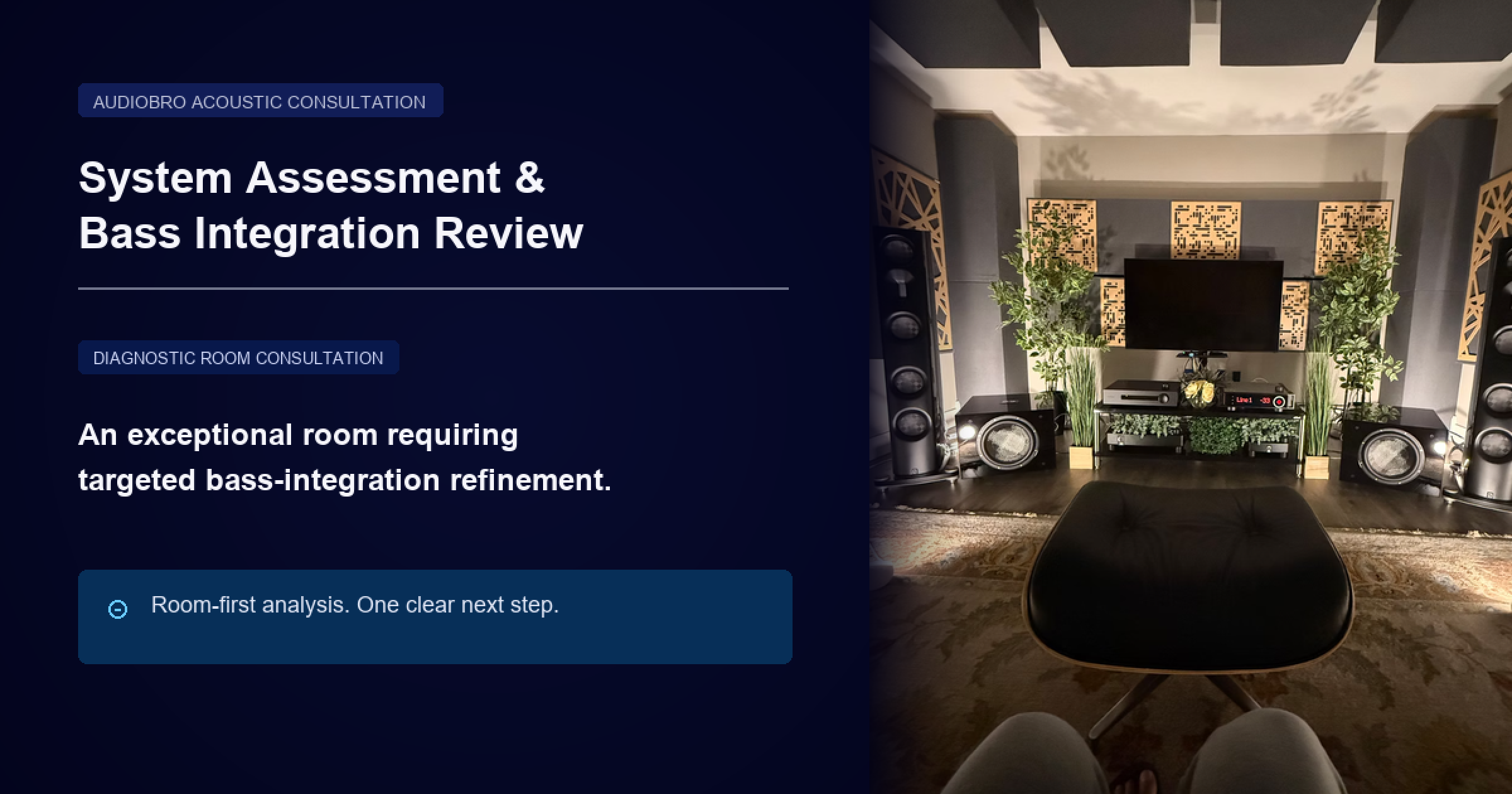
A high-end system can be beautifully designed, carefully treated and still have one remaining problem that refuses to disappear.
In this real AudioBro Room Review, the loudspeakers, electronics, listening position and acoustic treatment were already operating at an exceptionally high level.
The remaining concern was narrower:
Why did two highly capable REL subwoofers still produce inconsistent bass integration at the listening position?
This was not a case of correcting a poor room.
It was a case of refining an excellent one.
Review type: Diagnostic Room Consultation
Status: Placement trial completed · Customer reported a major audible improvement · Measurement verification remains available.
The Client and System
The client is a high-end two-channel listener with a dedicated, professionally treated listening room.
The system included:
- Børresen C3 loudspeakers
- Two REL Carbon Special Black Label subwoofers
- Aavik I-588 integrated amplifier
- Meitner MA3i streamer and DAC
- Ansuz D3 Mainz8 power distribution
- Extensive broadband absorption
- Corner treatment
- A large ceiling cloud
- A calibrated UMIK-1 measurement microphone available for verification
The equipment was not the obvious limitation.
The room had already received far more attention than most listening environments ever do.
The Challenge
The client had been adjusting the crossover configuration in an attempt to improve bass integration.
Those changes altered the presentation, but they did not consistently resolve the underlying inconsistency.
This raised an important diagnostic question:
Was the crossover itself the problem, or were the two subwoofers interacting with the room in a way that crossover changes alone could not correct?
AudioBro’s task was not to recommend more equipment.
It was to identify the most defensible next move while preserving the quality of the existing system.
Initial Room Assessment
The visual review found:
- Excellent left-to-right symmetry
- Strong loudspeaker placement
- A well-chosen listening position away from the rear wall
- Extensive broadband treatment
- Substantial ceiling-cloud coverage
- Effective corner treatment
- No obvious requirement for additional acoustic treatment
- No evidence that replacement equipment should be the first response
The central conclusion was simple:
This room required refinement rather than correction.
The visual assessment indicators were based on the supplied photographs and room information.
They were not acoustic measurements.
That distinction matters.
The photographs could establish that the room foundations were strong, but they could not prove how the two subwoofers combined at the listening position.
What BassMap Identified
Predictive BassMap modelling showed that both REL subwoofers occupied individually strong front-wall positions.
However, the combined-performance indicators were less convincing:
- Predicted smoothness: 63%
- Coverage overlap: 5%
- Predicted coherence: 74%
The individual front-left and front-right zones scored strongly.
The concern was not that either subwoofer occupied an obviously poor location.
The concern was their interaction as a pair.
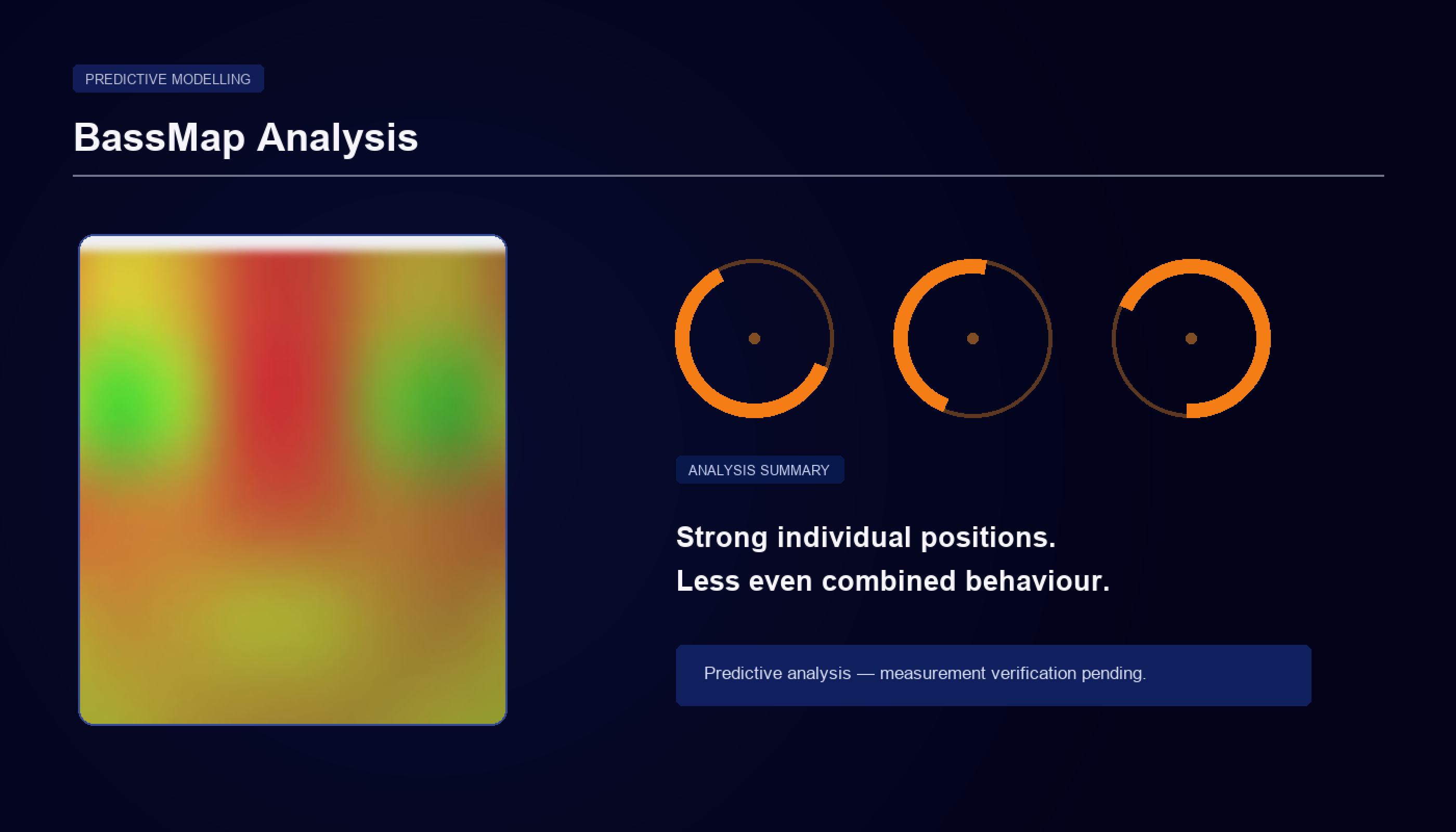
BassMap predicted that while both subwoofers occupied individually strong positions, their combined interaction at the listening position was likely limiting bass consistency. Measurement was recommended to verify the prediction.
This is an important distinction.
Two positions can each look strong in isolation and still produce a less even combined response at the listening seat.
BassMap did not prove that the existing layout was wrong.
It identified a plausible interaction problem worth testing.
Why Symmetrical Subwoofer Placement May Not Be Optimal
When two subwoofers occupy similar positions along the same wall, they tend to excite similar front-to-back modal patterns.
Depending on:
- acoustic distance
- phase
- delay
- crossover behaviour
- room dimensions
- listening position
their contributions may reinforce or cancel at particular frequencies.
This helps explain why adjusting the crossover can change the sound without consistently solving the problem.
The system may not need more bass output.
It may need a different spatial relationship between the two bass sources and the room.
Introducing controlled asymmetry can change the modal excitation pattern.
That does not guarantee improvement.
It creates a useful experiment.
The AudioBro Recommendation
AudioBro recommended preserving the existing crossover arrangement as the stable reference:
- Keep the 65 Hz high-pass
- Keep the 55 Hz low-pass
- Leave the left REL in its existing front-left position
- Preserve the current gain and phase settings
- Move only the right REL
- Trial the right REL in BassMap rear-left Zone 3
- Centre the trial around approximately 1.5 metres from the left wall and 5.2 metres from the front wall
- Allow approximately ±30 to 40 centimetres of local refinement
- Compare the original and trial layouts under identical conditions
The purpose was not to claim that the rear-left position was the final measured optimum.
It was to test whether changing one subwoofer’s boundary relationship produced a more even combined field.
One Change at a Time
The original right-subwoofer position should first be photographed and marked with removable tape.
The experiment then follows four steps:
- Preserve the current crossover, gain, phase, left-subwoofer position and listening seat.
- Mark the original right-subwoofer location so it can be restored exactly.
- Move only the right REL into the trial zone.
- Compare both layouts using the same tracks, playback level, seat and evaluation period.
This protects the integrity of the test.
If placement and crossover were changed simultaneously, there would be no reliable way to know which adjustment created the audible difference.
A reversible experiment produces useful information. An irreversible one produces doubt.
What AudioBro Did Not Recommend
The room review did not recommend:
| Possible response | AudioBro decision |
|---|---|
| Replace the loudspeakers | Not required |
| Replace the subwoofers | Not required |
| Add a third subwoofer | Not required |
| Add more acoustic treatment | Not indicated |
| Change the crossover immediately | Preserve the current reference |
| Apply EQ before testing placement | Not the first move |
| Change multiple variables together | Avoid |
| Test one physical change | Recommended |
This is a core part of the AudioBro approach.
The objective is not to create an expensive shopping list.
It is to identify the smallest defensible change capable of producing useful evidence.
What the Client Should Listen For
If the placement hypothesis is correct, the trial may produce:
- Tighter kick-drum impact
- Clearer bass-guitar pitch definition
- Less one-note or swollen bass
- Reduced upper-bass thickness
- Smoother note-to-note transitions
- Better integration between the REL subwoofers and Børresen loudspeakers
- Less need to change crossover settings between recordings
The client should also check for possible trade-offs:
- Loss of deep-bass extension
- Bass becoming localised behind the listener
- Reduced dynamics
- New rattles or resonances
- Weaker integration with the main loudspeakers
These are expected listening indicators.
They are not claimed outcomes.
The Verification Stage
There are three possible results.
Clearly Better
Keep the trial layout temporarily and proceed to UMIK-1 measurement for confirmation and refinement.
Worse
Restore the original marked position exactly.
No further guesswork is required.
Unclear
Stop moving equipment by ear and use the calibrated UMIK-1 microphone to compare the original and trial layouts.
The measurement stage should evaluate:
- Frequency response at the listening position
- Original versus trial placement
- Phase interaction
- Delay alignment
- Crossover integration
- Whether the result is repeatable
- Whether DSP refinement is needed after placement has been optimised
No improvement should be claimed without repeatable listening or measurement evidence.
The Final Action Plan
The client received a clear, reversible sequence:
- Keep the 65 Hz high-pass and 55 Hz low-pass reference
- Leave the left REL in the front-left position
- Photograph and mark the current right REL position
- Trial the right REL in rear-left Zone 3
- Compare Layout A and Layout B under identical conditions
- Keep the trial only if the improvement is repeatable
- Restore the original position if the result is worse
- Measure with the existing UMIK-1 if the result is unclear or requires refinement
The review did not attempt to manufacture a dramatic fault in an already excellent room.
It isolated the narrowest remaining opportunity and converted it into a controlled experiment.
The Diagnostic Outcome
At this stage, the confirmed outcome is not that the bass response improved.
The confirmed outcome is that the review:
- Established that the room foundations were already excellent
- Avoided unnecessary equipment and treatment recommendations
- Identified dual-subwoofer interaction as the most plausible remaining limitation
- Produced a specific and reversible placement trial
- Preserved a stable reference
- Defined the listening criteria
- Defined the measurement-verification stage
That is the purpose of a professional diagnostic review.
It replaces random adjustment with a structured next decision.
Key Takeaway
Great rooms do not stop needing optimisation. They simply require smaller, smarter changes.
In this case, the most credible next step was not another component, more treatment or a new crossover setting.
It was one controlled physical change, followed by listening and verification.
Every AudioBro Room Review includes a structured, evidence-based action plan tailored to the customer's room and system. This preview has been intentionally blurred to protect proprietary analysis methods while illustrating the depth of analysis provided.
Customer follow-up — one week later
Customer Outcome
After implementing AudioBro’s first recommended placement change, Charlie reported that the congestion was gone, bass response in the room had vastly improved and extended listening was now beyond his expectations. A US$97 Room Review had helped unlock substantially more performance from a six-figure room and system without another equipment purchase. He had zero complaints, wanted to explore what more was possible and asked which AudioBro subscription he should use to continue.
I was shocked. The congestion is gone, bass response in the room has vastly improved, and what I hear now is well beyond the expectations I had.
- Charlie implemented the first recommended change while the remaining setup variables stayed as the reference.
- He reported that the congestion was gone and bass response in the room had vastly improved.
- He was enjoying extended listening sessions and said the result was well beyond his expectations.
- He had zero complaints and wanted to explore what more was possible.
- Charlie asked which AudioBro subscription he should use to continue the process.
Planned continuation
What happens next
After asking which AudioBro subscription was appropriate, Charlie purchased Pro Lifetime. He will now get familiar with the platform and continue the same room investigation from the result already achieved.
- Measure the room, main loudspeakers and subwoofers to establish the next evidence baseline.
- Use Tune My Sub to examine whether the already satisfying bass can be refined further.
- Assess what additional performance may still be available from the highly capable main loudspeakers.
These are planned next steps, not completed outcomes. Any further improvement will be reported only after the relevant listening and measurement work has been completed.
This is Charlie’s customer-reported listening outcome, used with his permission. It is not measurement-verified: no matched UMIK-1 before-and-after comparison was completed, so the size, frequency range and measured cause of the change remain unverified.
Want AudioBro to Review Your Room?
AudioBro Room Review is designed for listeners who want a clear expert assessment of what is limiting their system and what they should do first.
You can provide:
- Room photographs
- Equipment details
- Room dimensions
- Calibration screenshots
- REW graphs or MDAT files
- Listening concerns
- Existing constraints
AudioBro then turns that evidence into a prioritised, practical plan.
Start your AudioBro Room Review
This case study documents the initial diagnostic consultation. The placement trial and UMIK-1 verification had not been completed at the time of publication. No measured or audible improvement is claimed.