
What Is SBIR?
Why It Happens
Direct sound meets reflected sound
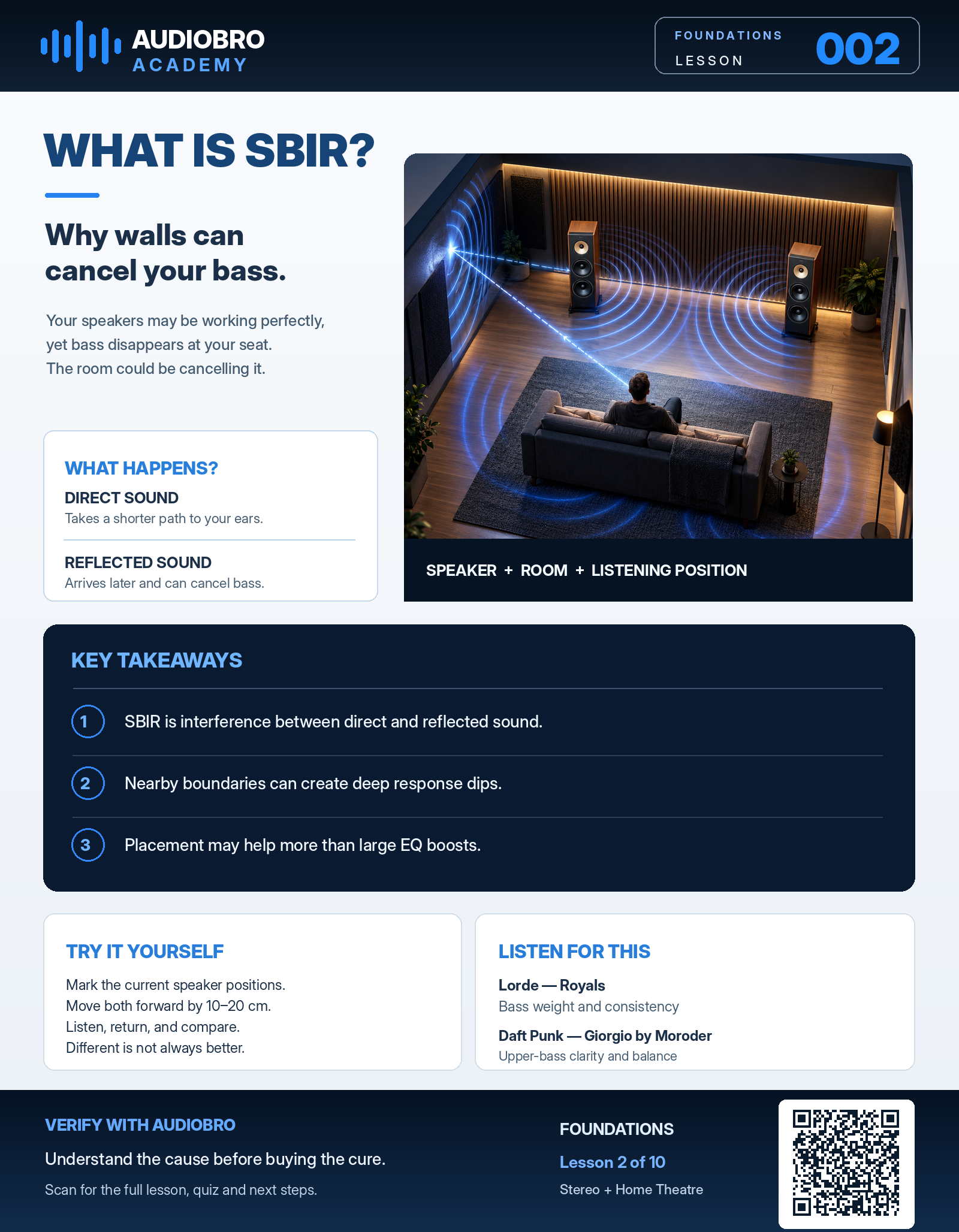
Every speaker produces sound into the room. The listener receives direct sound from the speaker and reflected sound from nearby boundaries.
The reflected sound travels further. That extra distance creates a delay.
When the reflected wave arrives sufficiently out of phase with the direct wave, the two partially cancel.
The result can be a deep reduction at a particular frequency. On a frequency-response graph, this often appears as a broad or deep dip.
The Boundary Matters
SBIR can involve reflections from:
- The wall behind the speakers
- Side walls
- Floor
- Ceiling
- Other large nearby boundaries
In many stereo systems, the front wall behind the speakers is particularly important because speaker-to-wall distance strongly influences the frequency at which a major cancellation occurs.
Move the speaker. You change the path length.
Change the path length. You change the cancellation frequency.
That is why relatively small placement changes can create surprisingly large differences.
The Simple Mental Model
Think of SBIR like two people pushing a swing. If both push at the same moment, the motion becomes stronger. If one pushes while the other pushes against it, some of the motion disappears.
Sound waves can behave similarly. Direct sound and reflected sound can add together or work against one another depending on their timing.
Why EQ Often Does Not Solve It
A common reaction to a response dip is:
“I'll just boost that frequency with EQ.”
But SBIR is often a geometry problem. If direct and reflected sound are cancelling each other acoustically, adding more electrical level may simply send more energy into the same cancellation.
This is why severe SBIR dips are often better addressed through speaker placement, listening position, boundary distance or acoustic treatment where appropriate before relying on large EQ boosts.
EQ can sometimes help. The lesson is to investigate geometry before trying to force a deep cancellation flat electronically.
SBIR vs Room Modes
These are often confused.
SBIR: Primarily caused by interaction between direct sound and a reflection from a nearby boundary.
Room modes: Created by standing-wave behaviour related to the dimensions of the room.
Both can create peaks and dips. But they are not the same problem. Because the causes differ, the solutions may differ too.
A graph tells you that a dip exists. It does not automatically tell you why.
The Big Idea
A frequency-response dip does not automatically mean your speaker is weak at that frequency.
Sometimes the speaker is producing plenty of energy. The room is simply cancelling part of it before it reaches you.
That is why changing equipment without understanding the cause can waste money.
Want the deeper explanation?
Read the complete SBIR guide for more detail and examples.