
Working Through a Difficult Room With Klipsch Cornwall IV
Customer-confirmed by listening · Early outcome · Continuing investigation · Not measurement-verified
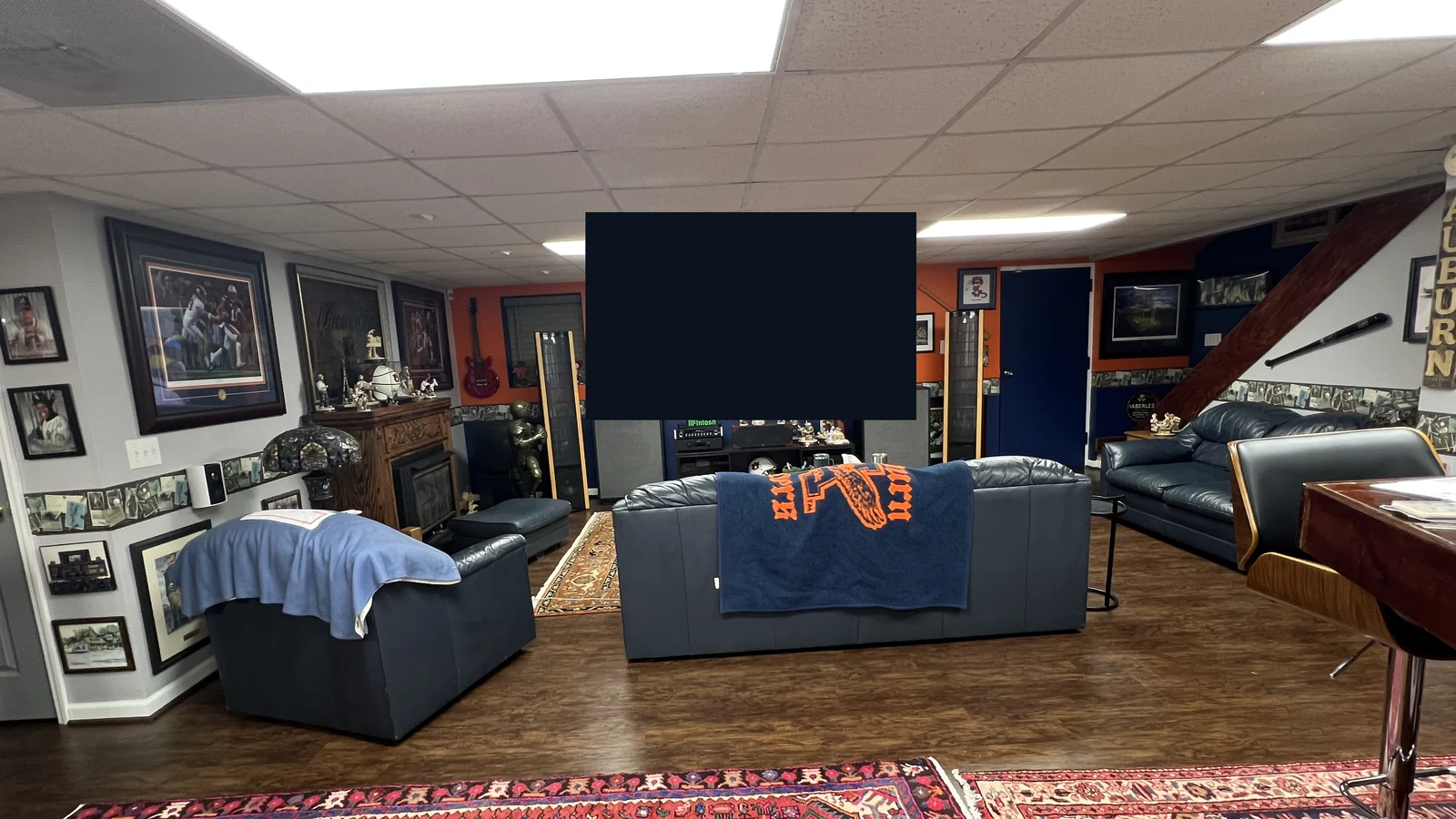
An experienced listener in a large, multipurpose private listening room had assembled Klipsch Cornwall IV loudspeakers, Hegel H190 amplification, a McIntosh MQ112 equalizer and two SVS SB-3000 subwoofers. The customer reported limited bass, inadequate low-frequency authority and bass nulls at the main listening position despite the substantial capability of the system. These were listening symptoms, not a measured diagnosis.
The System and The Challenge
Context: An experienced listener in a large, multipurpose private listening room
System: Klipsch Cornwall IV loudspeakers, Hegel H190 amplification, a McIntosh MQ112 equalizer and two SVS SB-3000 subwoofers
Symptoms: The customer reported limited bass, inadequate low-frequency authority and bass nulls at the main listening position despite the substantial capability of the system. These were listening symptoms, not a measured diagnosis.
Room Constraints
- Cornwalls positioned close to the front boundary
- Narrow loudspeaker spacing relative to the room and listening distance
- Limited visible toe-in at the starting point
- Both subwoofers concentrated in one front corner
- A listening seat in geometry that could be cancellation-prone
- A complex, asymmetric furnished room rather than a sealed listening rectangle
The Starting Point
The supplied photographs showed that the system already had ample nominal low-frequency capability. The useful comparison inside the same room was the neighbouring MartinLogan setup, which had greater front-wall clearance, wider spacing, more toe-in and a more coherent stereo triangle. That did not prove one loudspeaker was inherently better. It showed that placement geometry was a stronger first question than equipment replacement. The room photographs could support those observations, but they could not establish the depth, frequency or cause of the reported nulls.
Investigation & Modelling
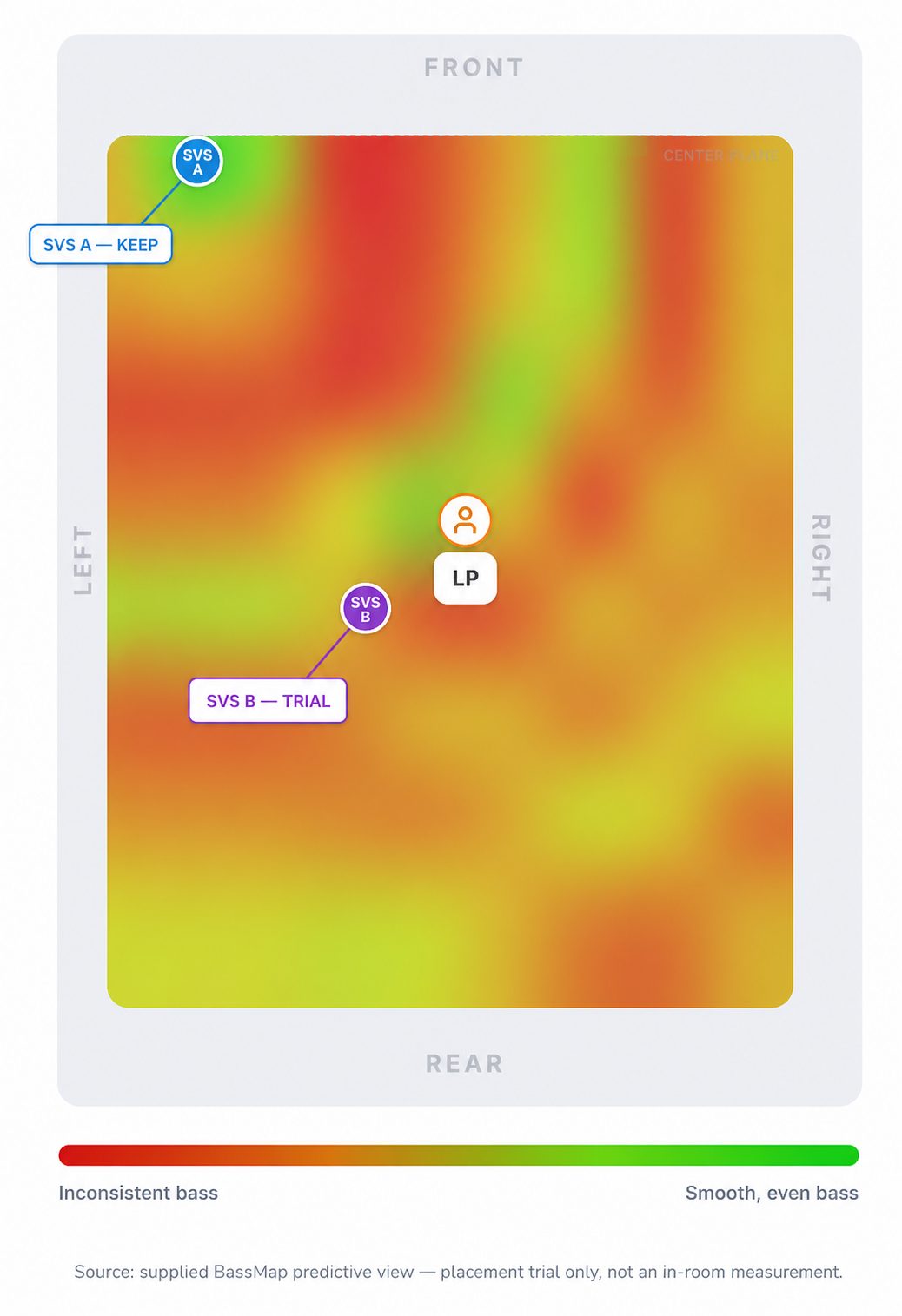
AudioBro kept three evidence layers separate. Photographs supported observations about boundary clearance, spacing, toe-in and the clustered subwoofers. Supplied geometry supported a working hypothesis that the seat could be in a cancellation-prone zone. A predictive low-frequency map then identified a reversible trial: retain one subwoofer as the front-left reference and move only the second toward the side or rear area near the listening position. The map was not an in-room measurement and did not prove a Jim-specific modal null.
Predictive room model and placement hypothesis—not an in-room measurement or verified acoustic result.
Implemented Placement Change
The customer had tried several familiar ideas individually before. AudioBro turned those variables into one coordinated setup trial so speaker position, toe-in, seat position and subwoofer placement could be evaluated as an interacting system rather than as unrelated adjustments.
- Removed the MartinLogans from the active trial area
- Widened the Cornwall spacing and angled the loudspeakers toward the listening position
- Moved the sofa rearward by approximately 2 ft
- Moved one SVS subwoofer from the clustered corner to the side wall near the sofa
- Evaluated the combined changes by listening
- Kept equipment replacement and broad EQ behind the geometry investigation
The customer reported better bass response from the subwoofers, mainly from the unit moved beside the listening area. Cornwall performance remained largely unchanged. That split result is useful but incomplete: it narrows the next investigation without pretending the central problem has been resolved.
Early outcome customer-confirmed by listening. No matched measurement verification has been completed.
Next Investigation
- Obtain updated photographs showing the exact Cornwall, sofa and both subwoofer positions
- Recalculate the geometry from the implemented positions
- Widen the Cornwalls further only if the updated geometry supports it
- Trial the sofa approximately 1 ft farther rearward
- Re-evaluate with the same familiar tracks and the MQ112 neutral
- Continue exhausting physical geometry before considering restrained EQ
- Use Jim-specific measurement if the remaining weakness cannot be resolved by geometry
The investigation is continuing. The next move is to update the physical evidence, test the remaining geometry deliberately and add measurement only if the unresolved Cornwall result requires it.
Next-stage investigation—not a completed treatment plan or final outcome.
Verification Pending
No Jim-specific REW measurement has been completed. The reported bass change is customer-confirmed by listening only, and the Cornwall result remains unresolved. Updated positions, controlled listening and—if needed—matched measurement are required before AudioBro can quantify response smoothness, null depth, frequency range, magnitude or repeatability. Any modal-null explanation remains a working hypothesis rather than a verified diagnosis.
Why This Case Matters
Honest room work does not need a manufactured transformation story. The coordinated trial produced one useful partial gain: perceived bass improved from the relocated subwoofer while the Cornwalls remained largely unchanged. That prevents a premature equipment purchase, avoids indiscriminate EQ and makes the next investigation more specific. AudioBro’s role was to order the variables, preserve the difference between prediction and proof, record the incomplete result and continue from what the room actually revealed.
Want AudioBro to review it for you?
If your system should sound better than it does and you want room-first guidance before spending more on equipment, AudioBro can review your room.