
AUDIOBRO / REAL CUSTOMER INVESTIGATION
From a quiet subwoofer to a settled listening reference
A controlled gain retest established the BK subwoofer’s contribution. Measurement and repeated listening then helped the customer decide which settings to retain—and which experiments to stop.
- MEASURED CHANGE
- ENGAGEMENT COMPLETE
01 / ROOM AND SYSTEM
The system and the challenge
The listener wanted greater low-bass contribution and scale without losing the midrange, treble and centre image already valued. A domestic fireplace layout and neighbour-friendly playback constrained placement and output.
System: DALI Rubicon 2 loudspeakers, BK XLS300-FF subwoofer, Sugden IA-4, Chord Mojo 2 and WiiM Ultra. This was historical, individually scoped founder-led optimisation, not a claim about the scope of a current fixed-price package.
What was heard: The connected subwoofer appeared to contribute little, while bass balance and definition remained inconsistent. These initial symptoms were separate from the later measured contribution finding.
- Protect the existing vocal and centre-image strengths.
- Respect the domestic layout and listening level.
- Change one variable and retain a return reference.
02 / STARTING EVIDENCE
The starting point
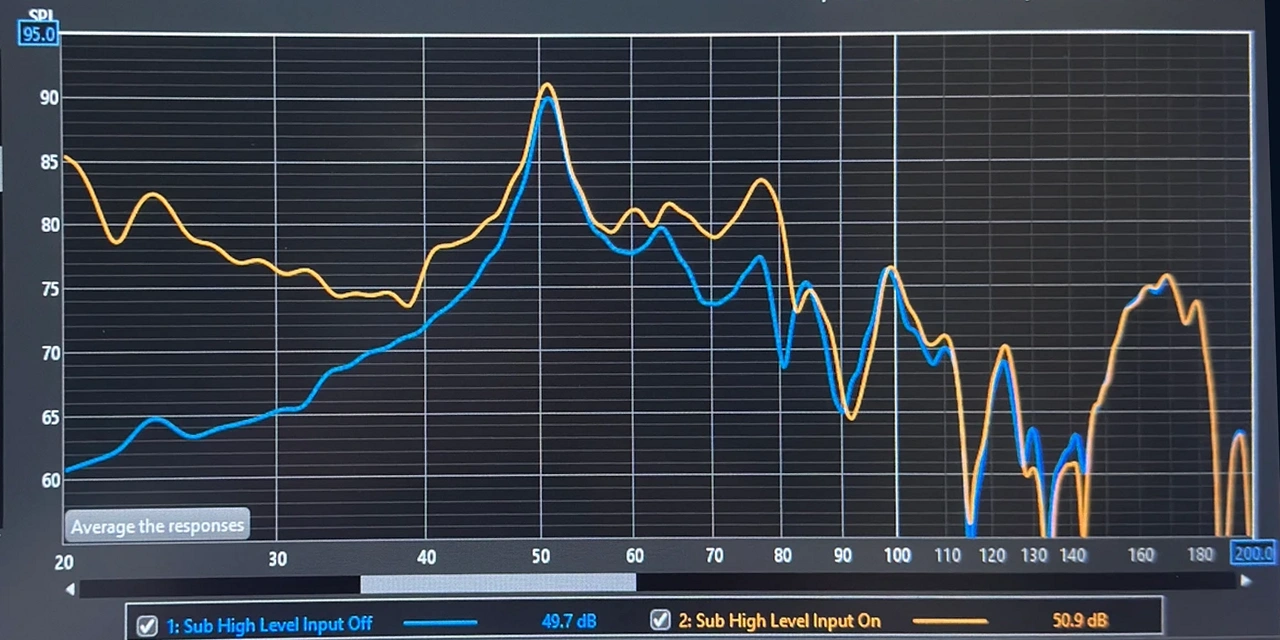
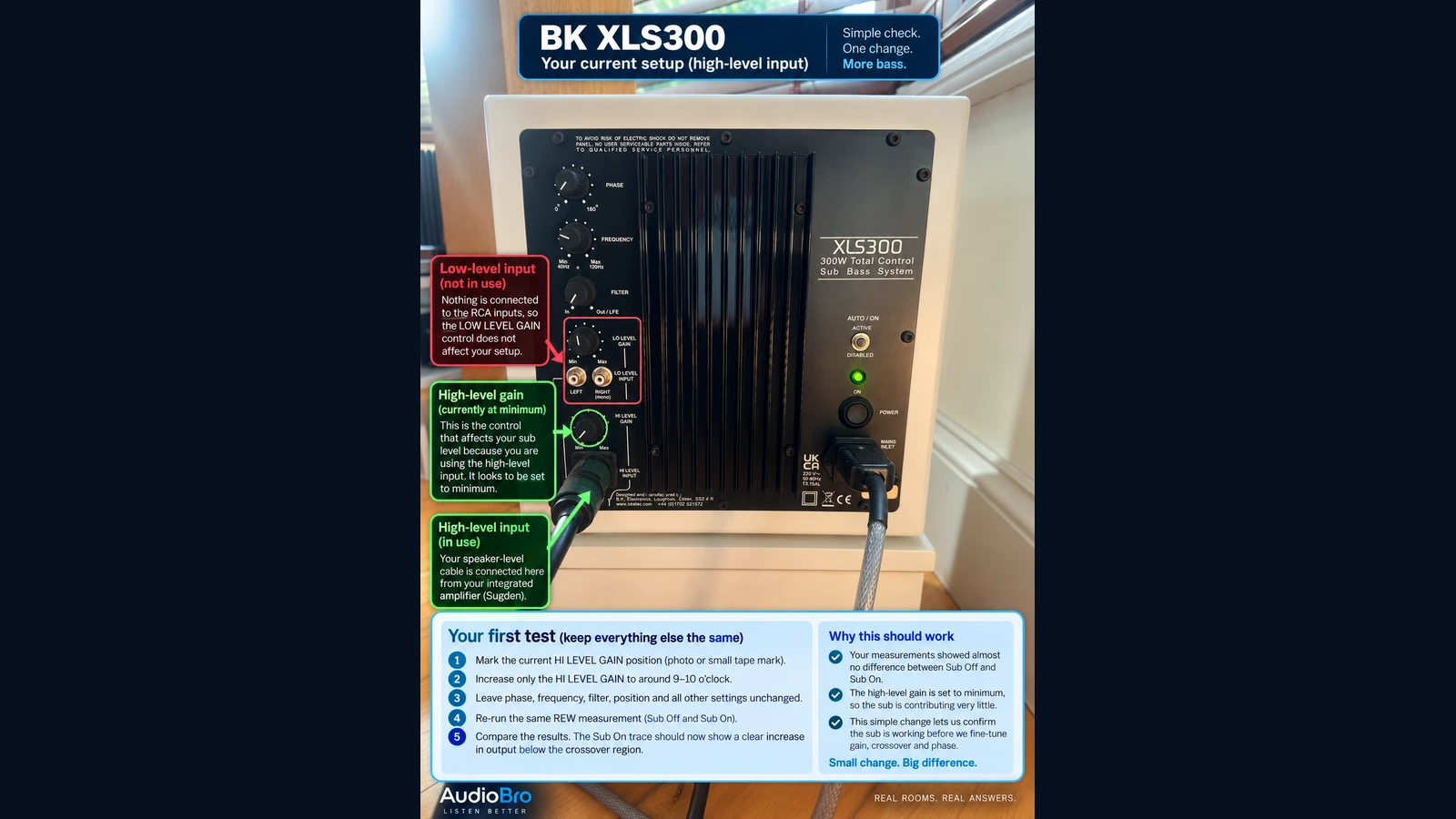
An early BK Off/BK On REW comparison showed little difference across much of the relevant bass range. A rear-panel photograph identified the active high-level input and gain near minimum. Increasing that gain alone and repeating the comparison established materially greater subwoofer contribution. This verifies the bounded gain finding, not a fully corrected room response.
The customer reported the following after the initial controlled gain intervention. This is the original phase, not a testimonial about every later experiment.
What AudioBro Room Review customer reported after the first Room Review
“The system sounds much more enjoyable now the sub is in play! Looking forward to your further input very much indeed. This is already money well spent.”
03 / THE DECISION
What changed the investigation
A higher setting restored contribution but became too heavy over sustained listening. Gain and FREQUENCY comparisons therefore continued. In October, stored WiiM-labelled traces differed by 3.05 dB at 50.5 Hz, consistent with the programmed filter difference; that did not establish everyday routing, cured response dips or solved decay. A panel comparison differed by only 0.06 dB near 50 Hz, so the panels were not presented as proven bass traps.
Initial BK contribution verified
The controlled off/on gain retest established greater subwoofer contribution, not complete room integration.
Verified for this finding onlyStored filter difference
A 3.05 dB difference at 50.5 Hz was consistent with the filter change in stored WiiM-labelled traces. Everyday routing and listening benefit remain separate.
Verification pendingFinal reference chosen by listening
The customer preferred the earlier reference and rejected E1, E2 and aiming benefits under the tested conditions.
Verification pending04 / TEST AND RESPONSE
Controlled tests—and a useful stopping point
The preferred reference combined BK gain near 9:30, the original FREQUENCY position and WiiM stereo PEQ at 50.0 Hz, −3.0 dB, Q 3.00. Basotect panels stayed by listening preference. These were the customer’s retained settings, not universal recommendations.
- Verify initial BK contribution with the controlled off/on gain retest.
- Compare gain and FREQUENCY independently, returning to the reference.
- Separate stored filter-trace differences from unverified everyday routing.
- Test deeper 50 Hz reduction, a 95 Hz lift and speaker aiming separately.
- Retain the earlier reference when the final tests did not help.
On 28 October, the customer reported that the deeper cut removed musical body, the 95 Hz experiment sounded thin or phasey, and aiming brought no image-height benefit. The earlier settings remained preferable. He chose to settle with the system and return to music. The engagement concluded by listening decision and an agreed reference—not a declaration that every room issue was solved.
05 / CURRENT STATE
Where the work stands
The completed engagement illustrates the current Review → Change → Remeasure → Refine approach. Its historical commercial scope was individually agreed; it must not be sold as evidence that today’s standard programme includes unlimited rounds.
Engagement complete. Retain the accepted reference; any new objective would need a separately agreed investigation.
MEASURED INITIAL BK CONTRIBUTION. Later preferences and rejected experiments are customer-reported. The WiiM-labelled delta is bounded to stored traces. Final full-room response, calibrated decay and image-height improvement are not verified.
Still open
- No final matched full-room response establishes that all remaining dips or decay are corrected.
- The later question about another subwoofer does not establish that future equipment changes were ruled out.
THE CUSTOMER’S OWN WORDS
A recommendation after the work
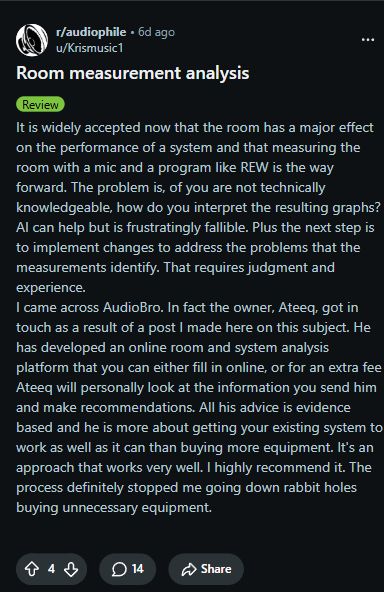
u/Krismusic1 shared this account of the engagement on Reddit. It is genuine customer feedback, not a star rating or independent verification of the acoustic findings.
THE CONSULTING LESSON
Why this case matters
A useful optimisation does more than make a graph change. It protects what works, tests an explanation, separates measurement from preference and recognises when another adjustment is not worth keeping.