
What's Really Happening In Your Room?
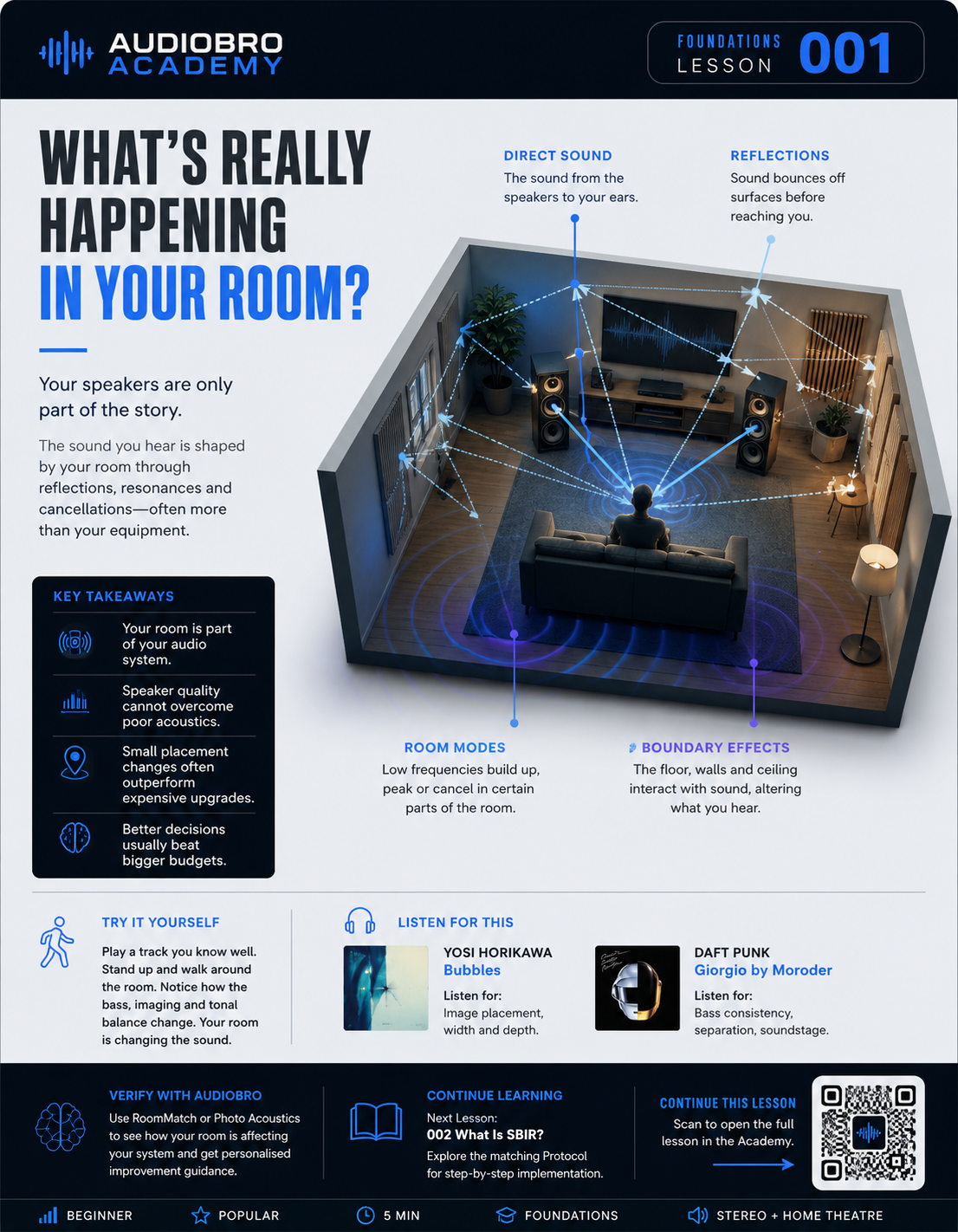
The Four Things You're Actually Hearing
1. Direct Sound
Direct sound travels from the speakers to your ears without first reflecting from another surface.
This is the clearest and most immediate part of what you hear.
It carries much of the timing, detail and spatial information that helps your brain locate voices and instruments.
2. Reflected Sound
Not all sound travels directly to you.
Some of it strikes the side walls, front wall, rear wall, floor, ceiling, windows and furniture before arriving at the listening position.
These reflections reach your ears slightly later than the direct sound.
When they are strong or arrive too early, they can blur imaging, reduce clarity and make the soundstage feel less focused.
Reflections are not automatically bad. Every normal room contains them.
The goal is to understand which reflections are helping the room feel natural and which ones are masking detail.
3. Room Modes
At low frequencies, sound behaves differently.
Bass wavelengths are long enough to interact strongly with the room's dimensions.
At certain frequencies, sound energy builds up. At others, it cancels.
These patterns are called room modes.
Room modes explain why bass can sound powerful in one seat, weak in another and uneven across the room—even though the subwoofer and volume setting have not changed.
4. Boundary Effects
Speakers and subwoofers interact with nearby walls, floors and ceilings.
The reflected sound from those boundaries combines with the direct sound.
Depending on the distance and frequency, the interaction can reinforce the sound or partially cancel it.
This is one reason moving a speaker or listening position by a relatively small amount can produce a surprisingly large change.
Your speakers create the sound. Your room shapes it.
Your equipment determines what the system is capable of producing.
Your room determines how much of that performance reaches you clearly.
Until you understand what the room is doing, it can be difficult to know whether a problem is caused by the equipment, the placement or the listening environment.
That is why AudioBro starts with the room before recommending more gear.