
The Upgrade Decision Ladder
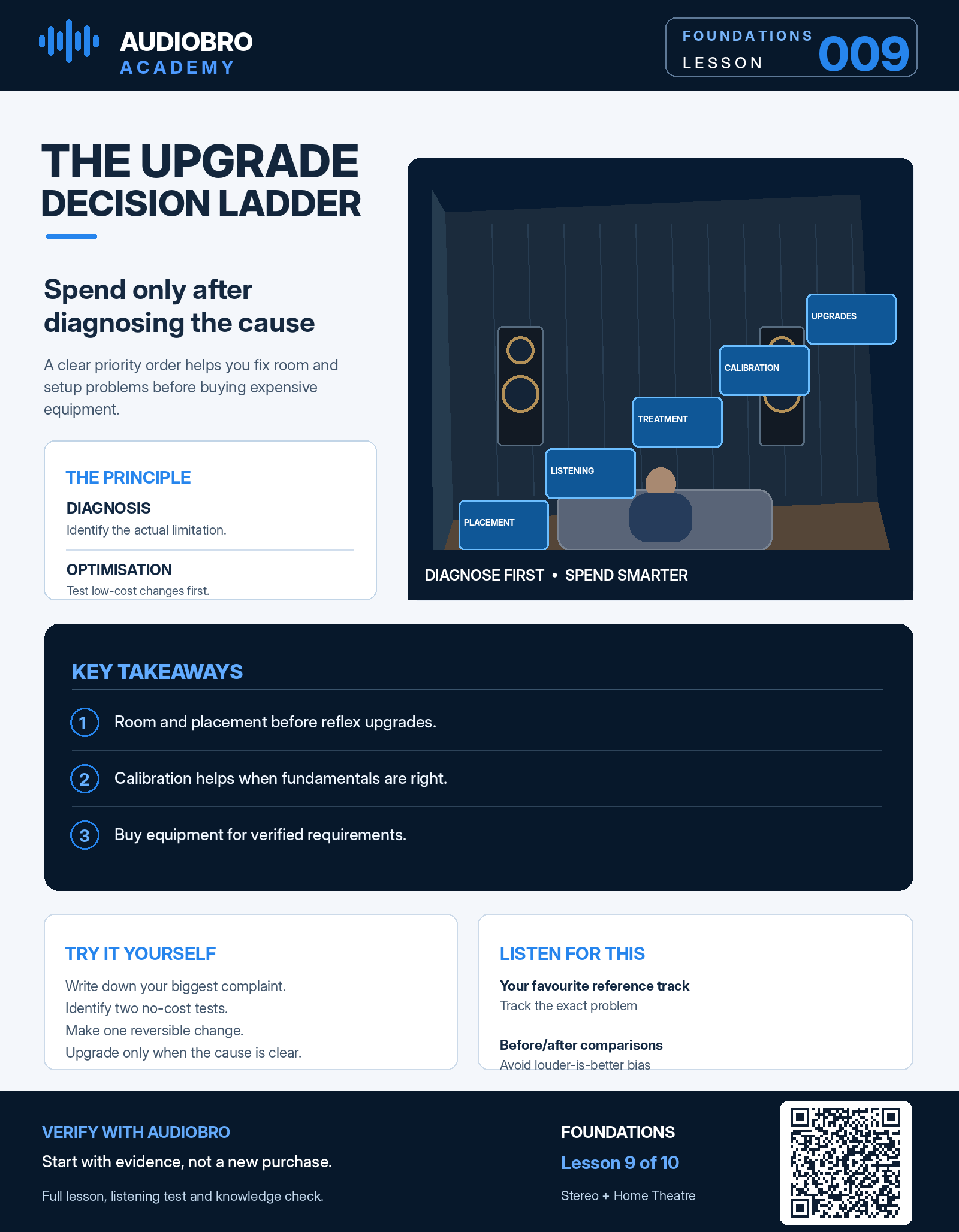
Step 1: Describe the Problem
Start with the symptom, not your preferred purchase. Is bass missing at one seat? Is dialogue unclear? Does the stereo image drift to one side? Does distortion occur only at high levels?
A precise complaint creates a more useful diagnostic question than “Which amplifier should I buy?”
Step 2: Check Setup and Geometry
Inspect obvious issues: speaker wiring and polarity, source settings, levels, blocked drivers, speaker spacing, toe-in, boundary distance and listening position.
Many of these checks cost nothing and are reversible. A 10–20 cm placement test may reveal a problem that more expensive components would not solve.
Step 3: Investigate the Room
Consider reflective surfaces, bass modes, boundary interference and asymmetry. When appropriate, collect room measurements and compare several listening positions.
Acoustic treatment can be worthwhile when it targets a defined problem and is suitable for the affected frequencies. Not every room needs panels in the same places.
Step 4: Check Calibration and Integration
Confirm sensible crossovers, speaker distances/delays, channel levels, subwoofer integration and the behaviour of any room-correction system.
Automatic calibration is a useful tool, but it can be limited by poor measurement placement, incorrect configuration or acoustic nulls that EQ cannot practically fill.
Step 5: Upgrade for a Verified Reason
There are valid hardware reasons to spend: inadequate amplifier power for required levels, distortion, missing features, insufficient bass output, a speaker unable to meet listening goals, or reliability problems.
Choose equipment that addresses the measured or clearly established limitation rather than buying to see whether something might improve.
This Is a Decision Framework, Not a Rigid Hierarchy
A broken driver, severe clipping or unsafe electrical issue should be addressed immediately. You do not need to complete every earlier step before repairing an obvious equipment fault.
The Big Idea
Spend after diagnosis. Where a free or inexpensive change addresses the cause, make that change first.