
Toe-In Explained
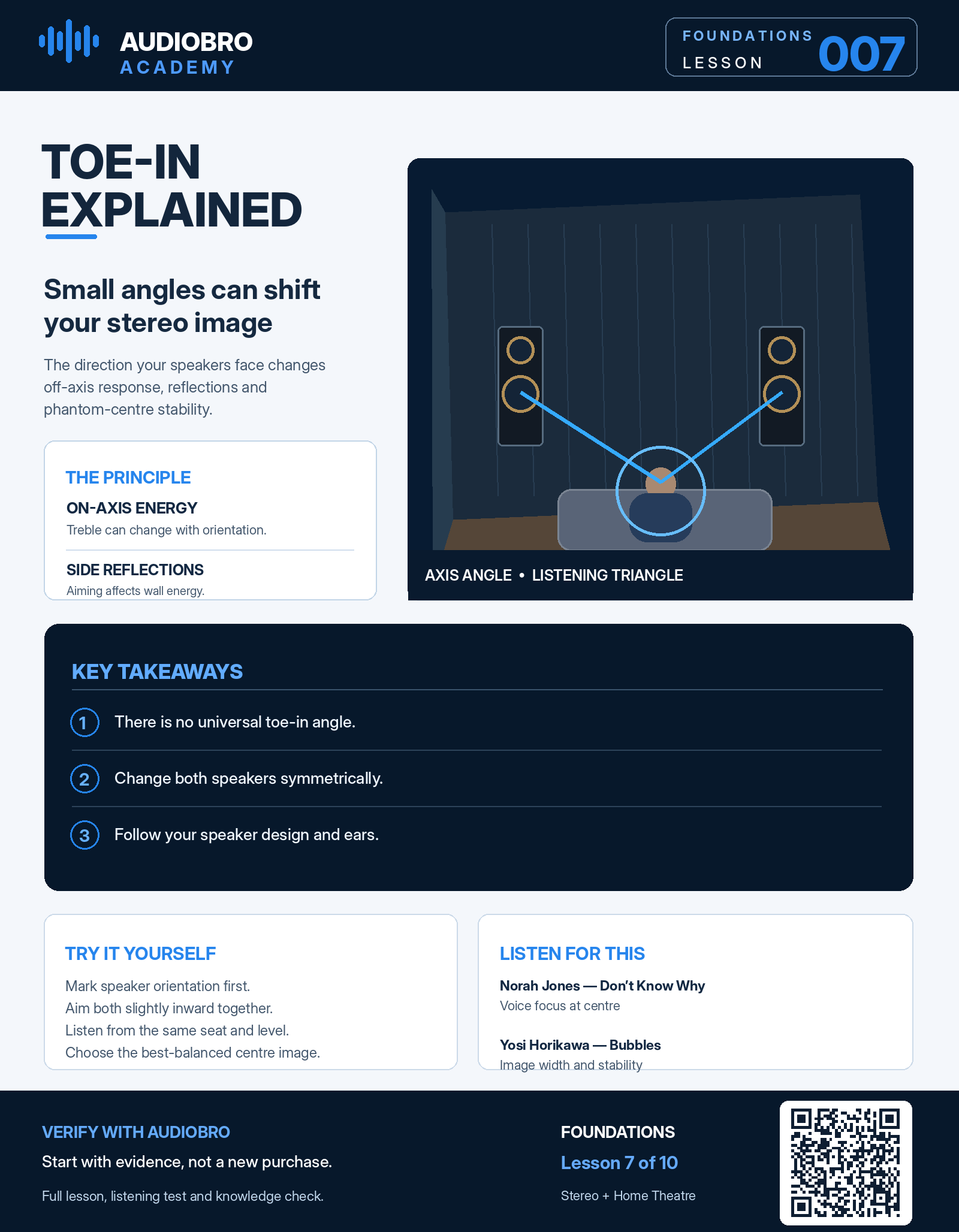
On-Axis and Off-Axis Sound
Speakers do not radiate the same frequency balance in every direction. Some maintain a fairly even response over a wide angle; others become quieter or change tonal balance more rapidly as you listen off-axis.
Changing toe-in changes which part of that directional behaviour reaches your ears. Depending on the speaker, this may affect treble balance, vocal focus and the perceived soundstage.
Toe-In Also Changes Reflections
Rotate a speaker and you change how strongly it illuminates different walls, although the exact effect depends on its radiation pattern and room layout.
A little more toe-in may reduce the energy reaching a side wall for some speakers, while also changing direct sound. It should never be advertised as a guaranteed cure for brightness or poor imaging.
Testing Toe-In Properly
Start by marking the current position and angle of both speakers. Face them straight ahead, or choose a repeatable baseline consistent with the manufacturer’s recommendation.
Now rotate both inward in small, symmetrical steps without changing their locations. Listen from the same seat at the same volume.
A stable central vocal is a useful clue. Also listen for a soundstage that is appropriately wide and well balanced, not just artificially sharp. Some designs work best aimed directly at the listener; others deliberately favour an off-axis response.
For off-centre seats, consider how the result changes for other listeners. An angle that locks one sweet spot into focus might not offer the best compromise for the room.
The Big Idea
Toe-in is a reversible way to tune directional balance and stereo imaging, but the speaker’s actual off-axis behaviour sets the rules.