
Room Modes Explained
Why It Happens
Bass wavelengths are long. A 50 Hz sound wave is roughly 6.9 metres long in air at ordinary room temperature. That makes the room's dimensions particularly important.
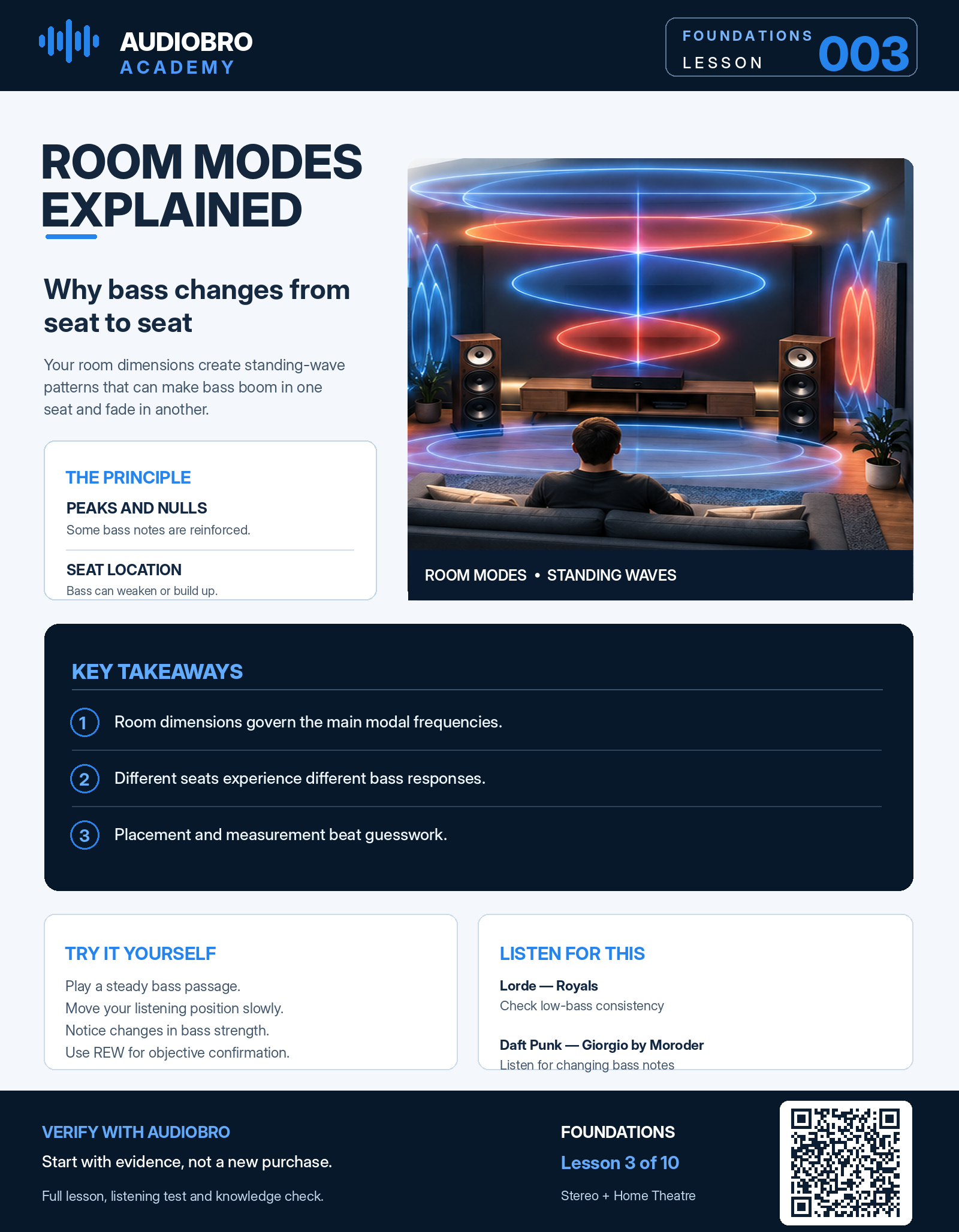
When reflected waves repeatedly interact with the walls, floor and ceiling, some low frequencies form standing-wave patterns. At certain places a mode has stronger sound pressure. Elsewhere the same mode has weaker pressure. The pattern depends on the frequency, room dimensions, source position and listening position.
In a rectangular room, the main families are called axial, tangential and oblique modes. Axial modes involve a pair of opposite boundaries, such as front and rear walls. They are a useful starting point because they are usually easier to understand and investigate.
Why Your Seat Changes the Result
Imagine a bass note that is strongly reinforced near one wall but substantially reduced near the centre of the room. If you move the listening chair, your ears enter a different part of that pressure pattern.
One seat may have exaggerated bass. Another may lack that note. Some notes can also take longer to decay, making the sound seem boomy or slow.
There is no single perfect listening position that works for every room. Seating must balance low-frequency behaviour with stereo imaging, comfort and the practical layout.
What Changes the Pattern?
Room dimensions: length, width and height help determine modal frequencies.
Speaker or subwoofer position: different locations excite each mode differently.
Listening position: moving the chair changes which peaks and dips are heard.
Multiple subwoofers: placed and configured well, they can help reduce seat-to-seat variation. Simply adding another sub does not guarantee better results.
Bass treatment: suitably designed and positioned absorption can reduce modal ringing. Thin decorative foam normally has limited effect at very low frequencies.
EQ: can often reduce a modal peak at the measurement position. It may not repair a deep acoustic null, or provide the same response across several seats.
Room Modes Are Not SBIR
Lesson 002 covered Speaker Boundary Interference Response, where direct and boundary-reflected sound interact through a path-length difference.
Room modes describe standing-wave behaviour in the enclosed space. Both can show up as peaks and dips on a frequency-response graph, and both can occur in the same system.
That is why a graph alone does not automatically tell you the cause.
The Big Idea
Smooth bass is not just about the subwoofer. It is about how the source, room and listener interact.
Before buying more equipment or boosting a missing note with EQ, test the positions you can change and measure the results where possible.