
Listening Position
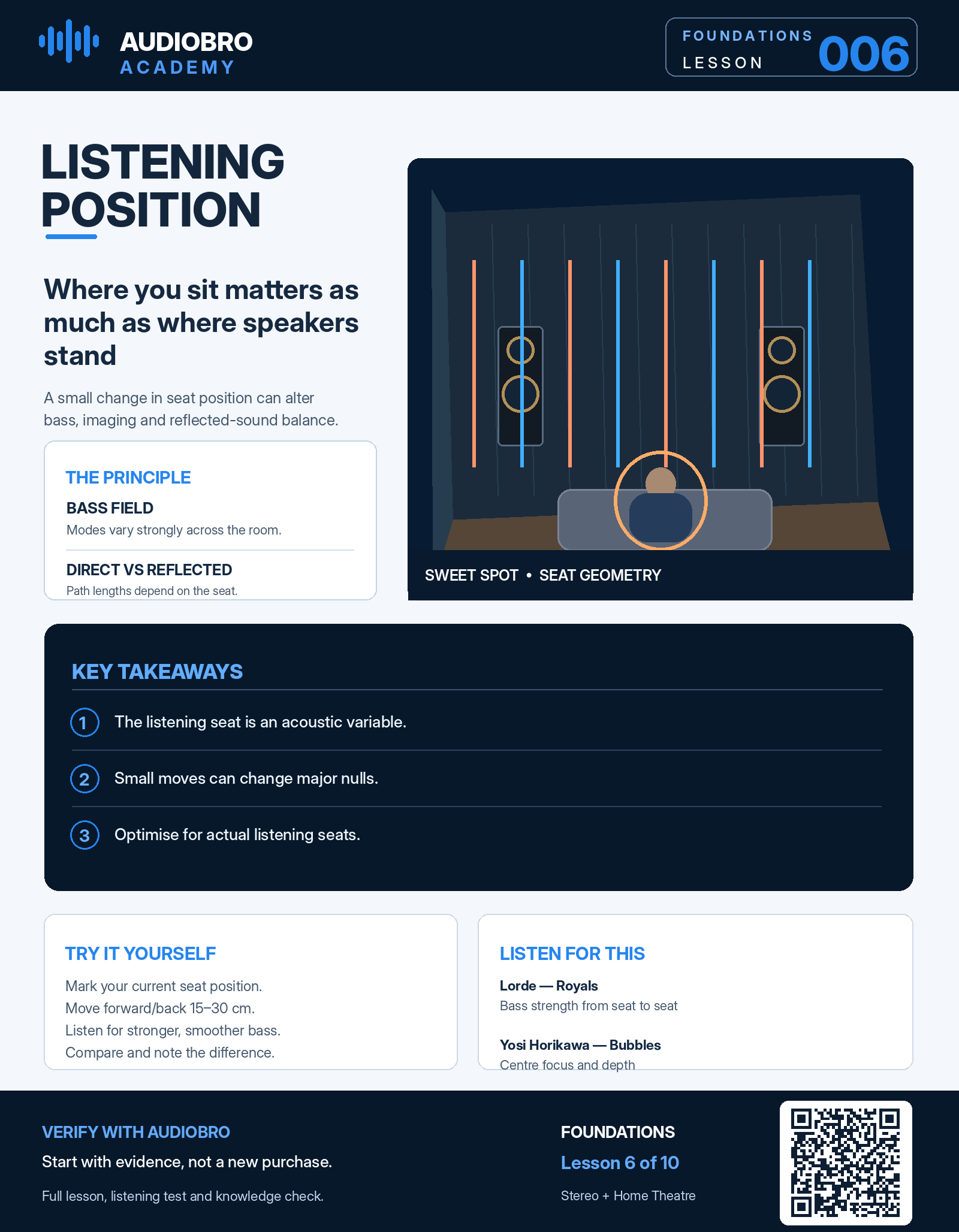
Why Seats Sound Different
At low frequencies, room modes create pressure patterns that vary across space. A position that sits near a pressure minimum at one frequency may sound weak at that note. Shift the seat and that weakness can change.
At higher frequencies, moving changes distances and angles to each speaker and to the room’s reflective surfaces. This affects the timing and level of arrivals at your ears, influencing image stability and tonal balance.
A Practical Starting Position
Begin with a sensible listening triangle and a seat clear of obvious obstacles. In a conventional rectangular room, sitting hard against the rear wall may increase exposure to some bass peaks and strong reflections. But avoiding that wall does not automatically reveal one ideal spot.
You may hear people recommend a fixed percentage of the room length. Treat that as a testing hypothesis, not a proven optimum. Real rooms have openings, furniture, non-rectangular geometry and different seat requirements.
Try Small, Reversible Changes
Moving a listening chair forward or back by 15–30 cm can materially change a low-frequency null. The result may be positive at one frequency and negative at another.
Compare several bass notes, not just a single track. Also check vocal centre, image width, sightlines and comfort. The best practical location balances the things you actually use the room for.
If you have more than one listening seat, aim for a good result across the main seats rather than maximising one perfect microphone position. Multiple subwoofers, carefully placed and integrated, may help consistency.
The Big Idea
The seat is not just where you enjoy the result. It is one of the variables that creates the result.