
First Reflection Points
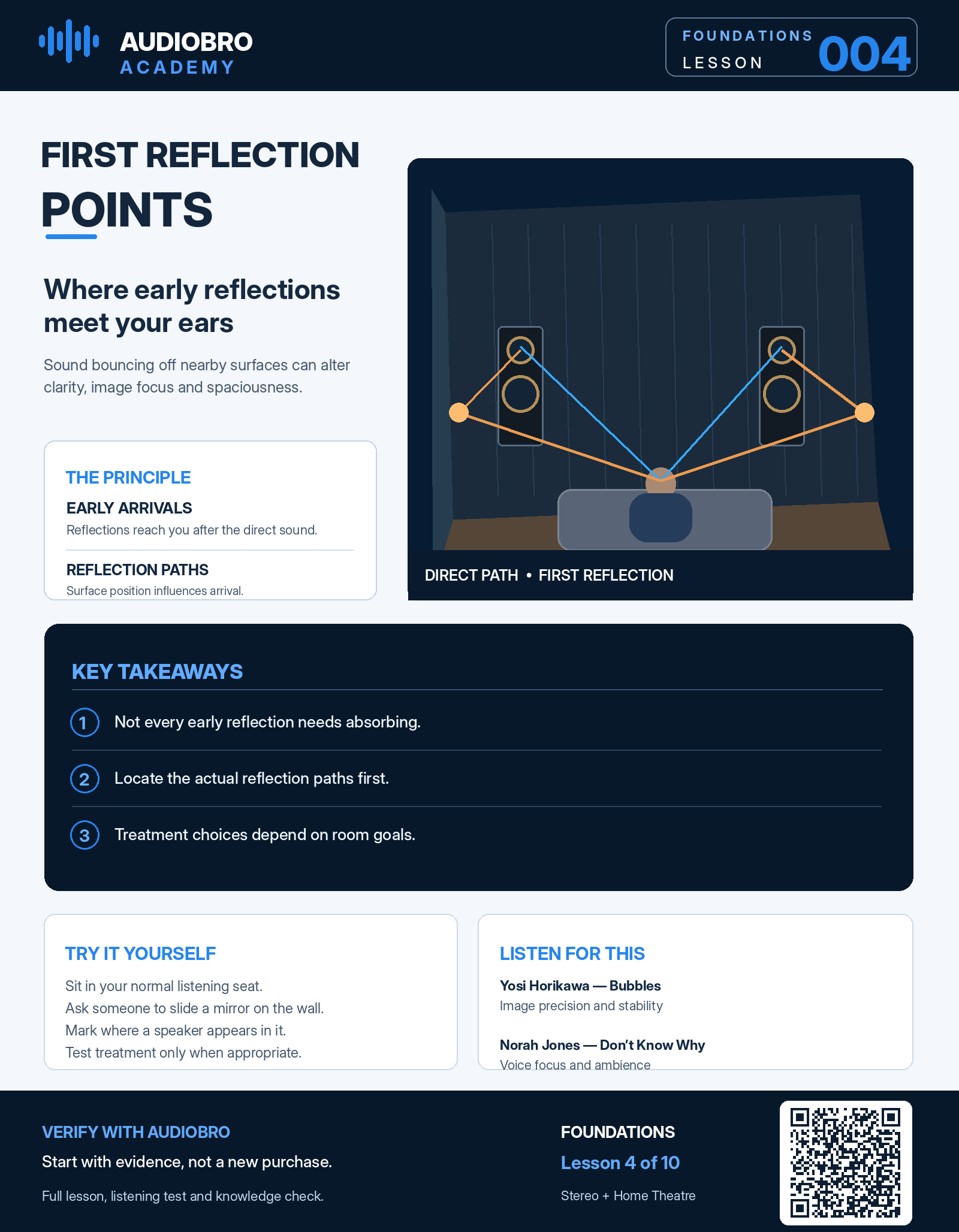
What Is a First Reflection Point?
Imagine a line from the speaker to a nearby wall and then to your ear. The place where the sound bounces is one possible first-reflection point.
On a smooth, approximately flat surface, the law of reflection gives a useful geometric model: the angle of incidence equals the angle of reflection. This model is especially useful at frequencies where the surface is large relative to the wavelength.
Real rooms are more complicated. Furniture, surface texture and speaker directivity affect reflected energy, and very low frequencies do not behave like neat rays.
Why the First Arrivals Matter
A strong reflection arriving shortly after direct sound can change the frequency response at the seat. Depending on its delay, spectrum and direction, it may also influence stereo image width, apparent spaciousness and precision.
That does not make every early reflection harmful. Some lateral energy can create a pleasant sense of width. The appropriate balance depends on the speaker, room, listening distance and whether the goal is music listening or precise monitoring.
Where Should You Look?
For conventional stereo speakers, side walls, the ceiling and the floor are common reflection paths. A desk or coffee table can also matter. A TV, windows and asymmetric furnishings may create very different responses for left and right speakers.
A widely used practical starting point is the mirror test. While seated at the main listening position, ask someone to move a mirror along a side wall. Where you can see the loudspeaker in the mirror is a likely specular reflection point for that speaker.
The test identifies a geometric candidate, not proof of an audible problem or a recommendation to absorb it.
Absorb, Diffuse or Leave It Alone?
Absorption reduces reflected energy in a frequency-dependent way. Thin panels are usually more effective in the mid and high frequencies than in deep bass.
Diffusion redistributes some reflected energy and requires appropriate design, distance and frequency range.
Leaving a reflection alone may be sensible when the room already sounds balanced or the reflection contributes positively to spaciousness.
Start with listening, placement and evidence. Treatment should solve a defined problem, not fill an empty patch of wall.
The Big Idea
Reflection control is a decision about energy, timing and the listening goal, not a blanket instruction to cover every reflective surface.